Mental Age vs. Chronological Age: Neuroscience of Cognitive Reserves and Brain Plasticity
Mental Age vs. Chronological Age: Neuroscience of Cognitive Reserves and Brain Plasticity
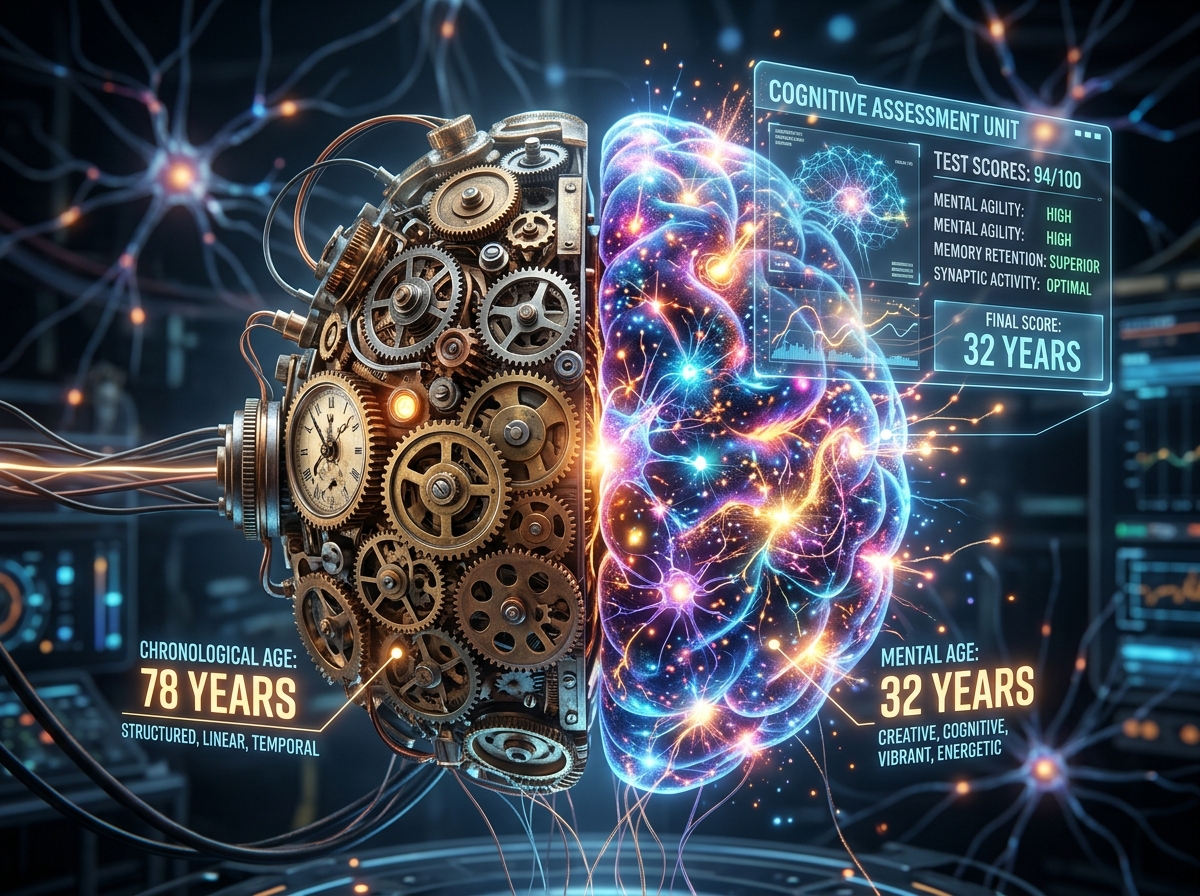
Time is often perceived as an absolute, uniform constant. We celebrate our birthdays on the same day every year, tracking our chronological progression with mathematical certainty. However, when we look inside the human brain—an incredibly complex organ composed of 86 billion neurons and hundreds of trillions of synaptic connections—we find that cognitive time is highly subjective and variable. This is the realm of Mental Age and Cognitive Age—behavioral and neurobiological measures of your brain's processing capacity, adaptability, and memory retention relative to chronological norms.
A striking phenomenon observed in cognitive science is the wide variation in mental age among individuals of the same chronological age. A 70-year-old individual can display the mental agility, learning capacity, and rapid reaction times of a 30-year-old, a state often called "super-aging." Conversely, a 35-year-old suffering from chronic stress, poor sleep, and cognitive stagnation can exhibit the processing speed and memory limitations of someone much older.
This comprehensive neurocognitive guide explores the biological mechanisms of brain aging, explains how to evaluate your cognitive age, and details the scientifically proven interventions required to build a resilient mind and keep your mental age young.
"The brain is like a muscle. When it is in use we feel very good, understanding is joyous. Learning is a form of cognitive rejuvenation." > — Carl Sagan
Section I: The Neurobiology of the Aging Mind
To understand how mental age can diverge from chronological age, we must examine the physical and chemical changes that occur in the brain over our lifespan.
1. Synaptic Density, Pruning, and Neuroplasticity In our youth, our brains exhibit high levels of neuroplasticity—the ability to physically reorganize neural pathways in response to new learning and experiences. This is facilitated by a high density of synapses and robust levels of Brain-Derived Neurotrophic Factor (BDNF), a protein that acts as "fertilizer" for our brain cells.
As we age chronologically, synaptic density naturally declines through a process of structural pruning. If we stop challenging our brains, this pruning accelerates, leaving us with rigid, well-worn neural pathways. This makes it harder to learn new skills or adapt to change—a classic sign of an advanced mental age.
2. Myelin Decay and Processing Speed The speed at which we process information depends on myelination—the protective fatty sheath that wraps around neuronal axons, acting as insulation for electrical signals. * In a youthful brain, thick myelin sheaths allow action potentials to travel at speeds up to 120 meters per second. * Starting in our 40s, myelin begins to undergo slow, natural degradation, creating micro-disruptions in electrical signals. This slow decay is why processing speed, working memory, and rapid decision-making tend to slow down over time.
Psychomotor Response Speed & Conduction Latency
Comparing healthy, cognitively active brain aging vs. sedentary accelerated cognitive decay pathways.
3. Neurotransmitter Volatility: Dopamine and Acetylcholine Our daily cognitive functions—focus, memory, drive, and learning—are governed by neurotransmitters: * Dopamine: Essential for motivation, working memory, and executive function. Dopamine receptor density declines by approximately 10% per decade starting in early adulthood, which can manifest as reduced cognitive drive and slower processing. * Acetylcholine: The primary neurotransmitter of memory and attention. Reductions in acetylcholine levels directly affect our ability to encode new memories and maintain sharp focus.
Section II: Fluid vs. Crystallized Intelligence: The Cognitive Divergence
One of the most encouraging discoveries in cognitive psychology is that different types of intelligence age in completely different ways. Psychologists divide our intellectual capacity into two distinct categories: Fluid Intelligence and Crystallized Intelligence.
Fluid vs. Crystallized Cognitive Trajectory
Illustrating how processing speed declines with chronological years while wisdom and semantic knowledge expand.
1. Fluid Intelligence ($G_f$) Fluid intelligence is the ability to think logically, reason abstractly, solve novel problems, and process information quickly, independent of acquired knowledge. It relies heavily on working memory capacity and neural conduction speed. * Aging Trajectory: Fluid intelligence typically peaks in our early 20s and undergoes a slow, steady decline throughout the rest of our lives. This decline reflects the natural physical changes of aging, such as myelin decay and reduced synaptic density.
2. Crystallized Intelligence ($G_c$) Crystallized intelligence is the accumulation of knowledge, vocabulary, wisdom, and skills acquired through education, career, and life experience. It is the biological foundation of wisdom. * Aging Trajectory: Crystallized intelligence remains incredibly stable and actually continues to grow well into our 60s, 70s, and even 80s. The brain compensates for slower processing speeds by drawing on a rich library of stored mental models and patterns, allowing older adults to solve complex problems with remarkable efficiency.
This divergence means that while your "fluid" mental age might slow down, your "crystallized" mental age can continue to grow, allowing you to maintain exceptional intellectual capability throughout your life.
Section III: The Concept of Cognitive Reserve
Why do some individuals with physical brain aging (even showing early signs of cellular decay) continue to perform beautifully on cognitive tests without showing any signs of decline? The answer lies in Cognitive Reserve.
Cognitive reserve is the brain's ability to improvise, find alternative neural pathways, and work around damaged areas to get the job done. It is built throughout our lives through: * Higher Education and Lifelong Learning: Constantly learning new, challenging subjects builds a rich, dense web of overlapping synaptic connections. * Complex Occupations: Careers that require active problem-solving, strategic thinking, and social interaction build a stronger cognitive buffer. * Bilingualism: Speaking multiple languages requires the brain to constantly manage and switch between different linguistic systems, strengthening executive control networks.
Think of cognitive reserve as a complex highway system. If a storm closes a major highway (representing cellular aging), a brain with high cognitive reserve can easily reroute traffic through local streets and secondary roads to reach the destination without delay.
Section IV: How to Lower Your Mental Age: The Cognitive Longevity Protocol
Just as physical exercise rejuvenates your muscles and cardiovascular system, targeted mental, physical, and dietary habits can systematically lower your mental age.
1. Cognitive Stimulation: The Principle of Desirable Difficulty To stimulate neuroplasticity and boost BDNF levels, your brain needs real challenges. Simple, repetitive puzzles like crosswords are not enough once your brain gets used to them. You must introduce desirable difficulty—activities that feel genuinely challenging and force your brain to build entirely new neural networks: * Learn a Musical Instrument: Playing an instrument requires the simultaneous coordination of visual, motor, auditory, and analytical pathways, making it the ultimate full-body workout for the brain. * Acquire a New Language: Learning a new language forces your brain to build new semantic structures and strengthens executive control. * Master Complex Skills: Activities like coding, chess, or learning to paint stimulate the growth of new connections and support brain health.
2. Physical Exercise: The Natural Brain Booster Physical exercise is one of the most powerful triggers for neuroplasticity. * BDNF Release: Cardiovascular exercise stimulates the release of BDNF in the hippocampus, the brain's primary memory center, promoting the growth of new brain cells (neurogenesis). * Vascular Perfusion: Exercise improves blood flow to the brain, delivering oxygen and essential nutrients while helping clear cellular waste products.
3. Sleep Architecture: The Brain's Night Shift During deep sleep, your brain activates its waste-disposal system—the glymphatic system. * Cellular Cleanup: Glial cells shrink by up to 60%, allowing cerebrospinal fluid to wash through the brain and clear toxic protein accumulations, such as amyloid-beta and tau. * Memory Consolidation: During REM and deep sleep, the brain replays and consolidates the day's learning, moving memories from short-term storage in the hippocampus to long-term storage in the neocortex.
Section V: Universal Truths and Famous Quotes on the Mind
- The Law of Synaptic Plasticity (Hebb's Law): "Neurons that fire together, wire together." Actively using neural pathways strengthens them, while inactive pathways are slowly pruned away.
- The Cognitive Buffer Principle: The physical size of the brain is less important than the density and complexity of its synaptic connections, which determine its overall processing power and resilience.
"Anyone who stops learning is old, whether at twenty or eighty. Anyone who keeps learning stays young. The greatest thing in life is to keep your mind young." > — Henry Ford
"The mind is not a vessel to be filled, but a fire to be kindled." > — Plutarch
Section VI: Frequently Asked Questions (FAQs)
Q1: Can a person's Mental Age truly be younger than their Chronological Age? Yes. If you are chronologically 65 but actively learn new skills, exercise regularly, stay socially engaged, and eat a healthy diet, your cognitive processing speed, working memory, and mental agility can easily match those of a healthy 35- or 40-year-old. This biological youthfulness of the mind is a key pillar of a long, healthy life.
Q2: Do brain-training games actually work to lower your mental age? Only partially. Most commercial brain-training games only make you better at playing those specific games. They rarely translate to broader, real-world cognitive improvements. To build true cognitive reserve, focus on learning complex, real-world skills that require active effort, such as learning a new language, mastering a musical instrument, or studying a new subject.
Q3: How does chronic stress affect my calculated mental age? Stress is highly destructive to the brain. Chronic stress floods the system with cortisol, which can damage and shrink the hippocampus—the brain's primary memory and emotional regulation center. This can lead to brain fog, memory issues, and slower processing, raising your mental age. Managing stress through regular exercise, mindfulness, and good sleep is essential for protecting your brain health.
Conclusion: Activating Your Neurocognitive Longevity Blueprint
Your brain is an incredibly adaptable, self-healing masterpiece. While chronological age moves in only one direction, your mental age is highly dynamic and responds directly to how you challenge, nourish, and care for your mind.
By embracing lifelong learning, staying physically active, prioritizing restful sleep, and actively building your cognitive reserve, you can maintain a sharp, vibrant, and youthful mind throughout your life. Use our Chronological Age Calculator to understand your biological timelines, challenge your brain with new experiences, and start your journey toward lifelong cognitive health today.