Lung Age vs. Chronological Age: Measuring Pulmonary Longevity and Respiratory Reserve
Lung Age vs. Chronological Age: Measuring Pulmonary Longevity and Respiratory Reserve
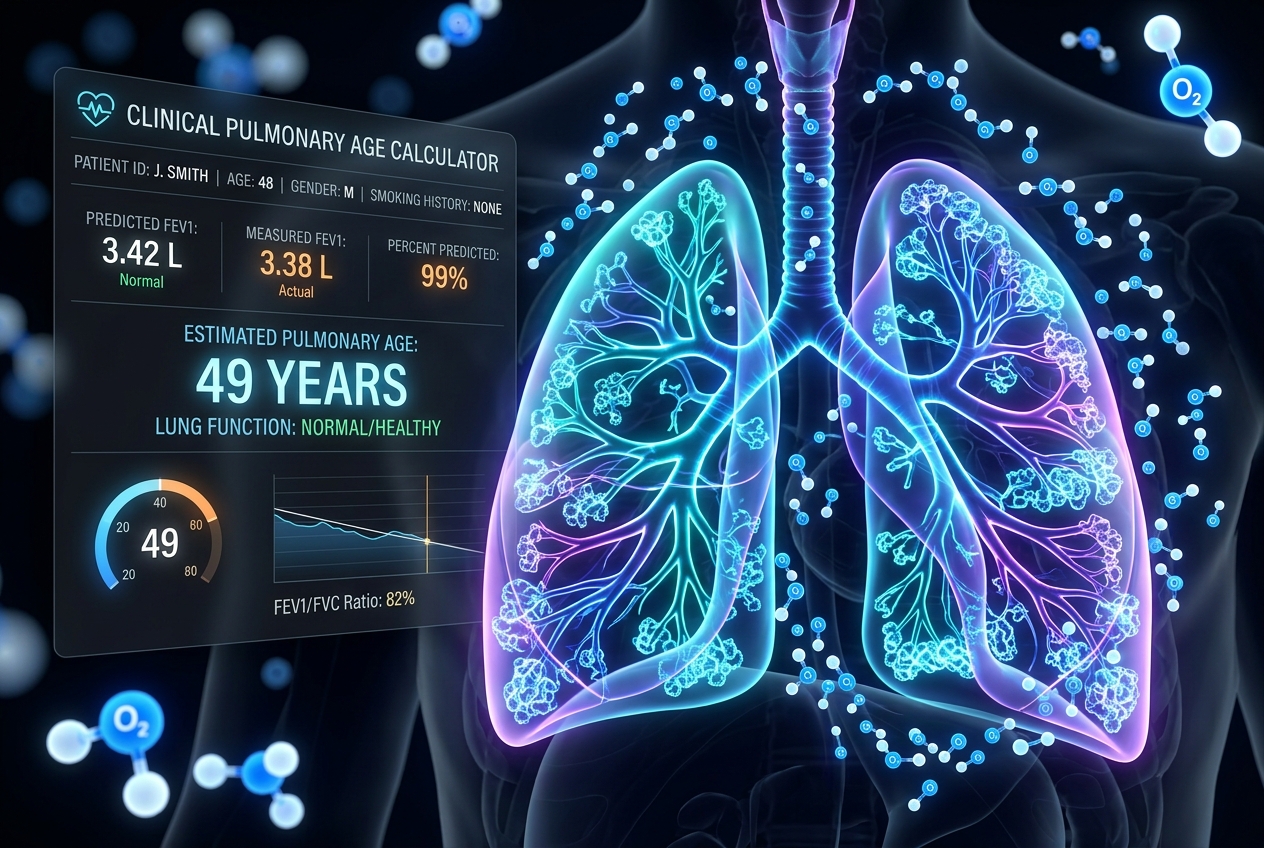
We take approximately 22,000 breaths every single day, moving over 11,000 liters of air through our respiratory system. This continuous exchange of oxygen and carbon dioxide is the biological foundation of cellular life. Yet, because our lungs are directly exposed to the external atmosphere, they are highly vulnerable to physical wear, environmental pollution, and biological aging. Your Lung Age is a physiological metric that measures your respiratory volume and forced expiratory power, comparing your lung health directly to the chronological averages of the population.
Your chronological age increases at a fixed rate, but your lung tissue may be aging much faster. A 50-year-old lifetime runner who has trained their respiratory muscles may possess a lung age of a 30-year-old, with massive oxygen delivery capacity and elastic lung tissues. Conversely, a 30-year-old sedentary office worker living in a highly polluted city may possess the stiff, restricted lung age of an 80-year-old.
This detailed pulmonology guide explores the physical mechanics of breathing, analyzes how pulmonary function decays over time, explains how spirometry determines your lung age, and provides a scientifically proven protocol to restore your lung compliance, expand your vital capacity, and keep your respiratory systems youthful.
"The breath of life is the physical manifestation of our life force. By controlling and expanding our lung capacity, we directly influence our vitality and longevity." > — Universal Physiological Maxim
Section I: The Physical Mechanics of Respiration: Ventilation and Perfusion
To understand how lung age diverges from chronological age, we must master the biophysics of breathing. The lungs are not active muscles; they are passive, elastic organs that rely on pressure differentials to move air.
1. The Respiratory Pump: Diaphragm and Intercostals * Inspiration (Inhaling) is an active process. The dome-shaped diaphragm contracts and flattens, moving downward while the external intercostal muscles pull the ribs up and out. This expands the thoracic cavity, creating a negative pressure (relative to the atmosphere) that draws air into the lungs. * Expiration (Exhaling) is typically a passive process. The diaphragm and intercostal muscles relax, and the natural elastic recoil of the lung tissue pushes air out.
2. The Bronchial Tree and Alveolar Gas Exchange Air travels down the trachea, through the branching network of the left and right bronchi, and into millions of tiny, microscopic air sacs called alveoli: * The human lungs contain approximately 300 million alveoli, wrapped in a dense web of capillaries. * This arrangement creates a massive surface area of up to 70 to 100 square meters—roughly the size of a tennis court—all packed into your chest cavity. * Oxygen and carbon dioxide pass across the ultra-thin alveolar-capillary membrane via simple passive diffusion, moving from areas of high concentration to low concentration.
Section II: Elastic Recoil vs. Stiffening: The Biophysics of Pulmonary Aging
As we age chronologically, the structural proteins that support our respiratory system undergo predictable physical changes, directly affecting how easily we can breathe.
1. Loss of Pulmonary Elastic Recoil Lung tissue is packed with elastin fibers, which allow the lungs to stretch like a rubber band during inhalation and snap back during exhalation. * Starting in our 20s, enzymatic degradation and oxidative stress slowly break down these elastin fibers. * This loss of elasticity reduces the lung's natural "elastic recoil." * Consequently, the lungs become overly floppy, making it harder to empty them completely during exhalation. This leads to air trapping, where stale, low-oxygen air remains trapped in the lower lungs, driving up your lung age.
2. Stiffening of the Chest Wall and Thoracic Cage While the lung tissue itself becomes floppy, the surrounding structural cage becomes stiff and rigid: * Costal cartilages that connect your ribs to your breastbone undergo slow calcification, reducing their flexibility. * The joints of the thoracic spine stiffen, restricting the physical expansion of your chest during deep breaths. * The Result: The physical work required to breathe increases dramatically, reducing your overall respiratory efficiency.
Forced Expiratory Volume (FEV1) Decay Over Time
Comparing FEV1 capacity (Liters) in cardiorespiratory-trained individuals vs. sedentary individuals.
Section III: How Lung Age is Calculated: The Spirometry Parameters
Spirometry is the gold-standard clinical tool used to measure lung function and calculate lung age. It tracks how much air you can breathe in, and how quickly and forcefully you can blow it out.
1. Key Spirometric Measurements * Forced Vital Capacity (FVC): The total volume of air you can forcefully exhale after taking the deepest possible breath. * Forced Expiratory Volume in 1 Second ($FEV_1$): The volume of air you can forcefully blow out during the very first second of expiration. This is the single most critical indicator of airway health and patency. * $FEV_1/FVC$ Ratio: The proportion of your vital capacity that you can exhale in the first second. A healthy ratio is typically between 75% and 85%. A lower ratio indicates airway obstruction (such as asthma or COPD).
2. The Morris and Temple Lung Age Formula Clinical lung age calculators use established regression formulas (such as those developed by Morris and Temple) to estimate your lung age based on your $FEV_1$ performance:
$$\text{Lung Age}_{\text{Male}} = 2.24 \times \text{Height (inches)} - 33.3 \times FEV_1 \text{ (Liters)} - 23.5$$
$$\text{Lung Age}_{\text{Female}} = 1.13 \times \text{Height (inches)} - 19.0 \times FEV_1 \text{ (Liters)} - 12.0$$
If your measured $FEV_1$ is significantly lower than expected for your height and sex, the formula will output a lung age that is decades older than your chronological age, signaling potential respiratory issues.
Alveolar Gas Exchange Surface Area Decline
Gas diffusion surface area (m²) over time, comparing clean air habits vs. chronic smoke/PM2.5 exposure.
Section IV: Environmental Threats: PM2.5, Vaping, and Chronic Inflammation
Your lungs are highly vulnerable to environmental stressors. Because they are in constant contact with the air we breathe, environmental toxins can rapidly accelerate pulmonary aging.
1. Particulate Matter (PM2.5) and Alveolar Destruction Particulate matter with a diameter of less than 2.5 micrometers (PM2.5) is so tiny that it bypasses the protective mucus and cilia of your upper airways, traveling deep into your alveoli: * Once inside, these toxic particles trigger a powerful local immune response. * Macrophages release inflammatory chemicals and enzymes (like matrix metalloproteinases) to destroy the foreign invaders. * Over time, this chronic inflammation also destroys the delicate alveolar walls, a condition called emphysema, permanently reducing the surface area available for oxygen exchange.
2. The Myth of "Safe" Vaping While marketed as a safe alternative to smoking, vaping aerosol contains ultra-fine chemical particles, volatile organic compounds, and heavy metals (such as nickel, tin, and lead): * These toxic chemicals cause immediate inflammation and damage to the delicate endothelial cells lining your pulmonary capillaries. * Vaping triggers bronchial hyperreactivity and impairs the function of cilia—the tiny, hair-like structures that sweep dust and mucus out of your lungs—increasing your susceptibility to infections and accelerating overall lung aging.
Section V: The Pulmonary Restoration Protocol: Keeping Your Lungs Young
You do not have to let your lungs age helplessly. With a targeted, science-backed approach combining respiratory muscle training, cardiorespiratory exercise, and optimal air quality, you can expand your lung volumes and keep your respiratory systems youthful.
1. Inspiratory Muscle Training (IMT): Resistance Work for Your Diaphragm Just as you lift weights to strengthen your biceps, you can use specialized resistance devices to strengthen your breathing muscles. * Mechanism: IMT devices force you to inhale against a calibrated resistance, strengthening your diaphragm and external intercostal muscles. * The Protocol: Use an IMT device (such as a Powerbreathe) twice daily for 30 breaths at a resistance set to 50% to 60% of your maximum inspiratory pressure. Studies show this protocol significantly increases $FEV_1$ and improves exercise tolerance.
2. High-Intensity Interval Training (HIIT): Forcing Respiratory Adaptation While moderate cardio is excellent, high-intensity training forces your body to adapt to extreme respiratory demands: * Mechanism: HIIT triggers deep, rapid breathing that stretches lung tissue to its absolute limits, keeping costal cartilage flexible and expanding vital capacity. * Protocol: Perform one HIIT session per week, consisting of 4 to 5 intervals of 4 minutes of hard effort (at 90% of max heart rate) followed by 3 minutes of active recovery.
3. Diaphragmatic and Box Breathing: Restoring Lung Volumes Many individuals use shallow, restricted chest breathing, which leaves the lower third of their lungs unventilated: * Mechanism: Deep diaphragmatic breathing fully expands the lower lobes of the lungs, preventing atelectasis (micro-collapse of alveoli) and optimizing gas exchange. * Protocol: Spend 10 minutes daily practicing Box Breathing: inhale for 4 seconds, hold for 4 seconds, exhale for 4 seconds, and hold empty for 4 seconds, focusing on pushing your belly out with each breath.
Frequently Asked Questions (FAQs)
Q1: Is lung age the same as physical fitness? Not exactly, but they are closely linked. Lung age specifically measures your physical airway flow and lung volumes ($FEV_1$ and $FVC$), whereas overall physical fitness is also governed by your cardiovascular efficiency, blood volume, and muscle oxygen extraction. However, having an optimal lung age is an absolute prerequisite to achieving elite physical fitness and endurance.
Q2: Can you rebuild damaged lung tissue? Delicate alveoli destroyed by severe emphysema or chronic smoking cannot be reconstructed. However, you can significantly improve the function of your remaining healthy lung tissue, strengthen your breathing muscles, and increase the flexibility of your chest wall. This dramatic boost in overall respiratory efficiency can substantially lower your calculated lung age.
Q3: How do air purifiers protect my lung age? High-quality air purifiers equipped with HEPA filters remove up to 99.97% of airborne particulate matter, including PM2.5, dust, mold spores, and allergens. By keeping your indoor air clean, you eliminate the primary source of chronic, low-grade pulmonary inflammation, preventing accelerated lung tissue damage and safeguarding your long-term respiratory health.
"Every deep breath is a renewal of cellular energy. Protect the health of your lungs, and let your breathing be deep, calm, and full of life." > — Legendary Respiratory Wisdom