Heart Age vs. Chronological Age: Decoding Cardiovascular Longevity and Vascular Health
Heart Age vs. Chronological Age: Decoding Cardiovascular Longevity and Vascular Health
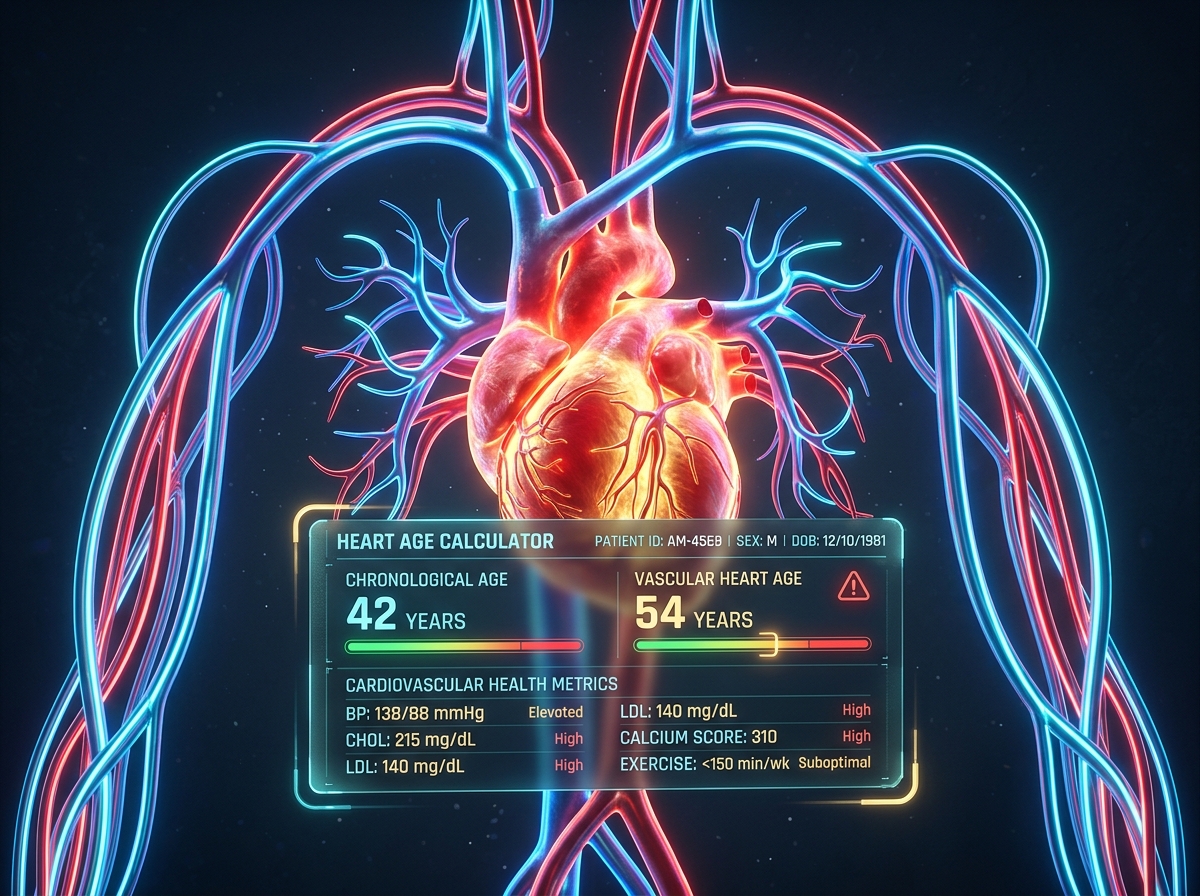
The standard calendar measures our lives by the number of times we orbit the sun. This is our chronological age—an immutable, uniform progression of time. However, deep within our thoracic cavity, a muscular pump of remarkable efficiency operates on a completely different temporal scale. Your heart does not count orbits; it counts beats, handles pressures, and experiences shear stress. This is the foundation of Heart Age—a biological and clinical metric that measures the wear, tear, and physiological integrity of your cardiovascular system relative to demographic standards.
For millions of individuals worldwide, a profound and dangerous discrepancy exists: their vascular systems are decades older than their birth certificates suggest. A 45-year-old individual, based on standard risk factors, may possess a heart age of 65. Conversely, an individual who actively manages their metabolic and vascular health can maintain a heart age far below their chronological years.
This comprehensive medical guide explores the intricate physiology of vascular aging, explains the mathematical models used to compute heart age, and details the actionable lifestyle, dietary, and clinical interventions required to align—or even reverse—your heart's biological clock relative to your chronological years.
"A man is as old as his arteries." > — Thomas Sydenham, English Physician (1624–1689)
Section I: The Biophysical Underpinnings of Vascular Aging
To understand why your heart can age faster than your chronological timeline, we must examine the biophysical changes that occur within our blood vessels over time. The human vascular network is not a system of static, inert pipes. It is a highly dynamic, living, endothelial-lined conduit system that constantly adapts to pressure, hormonal signals, and metabolic inputs.
As we age chronologically, two primary pathological processes govern the degradation of our blood vessels: arteriosclerosis (the stiffening of the large elastic arteries) and atherosclerosis (the inflammatory accumulation of lipid-rich plaques within the arterial walls).
1. Arterial Stiffening and Elastin Degradation In a youthful state, the aorta and other major arteries act as dynamic pressure-dampening chambers. During cardiac systole (contraction), these vessels expand to absorb the massive volume of blood ejected by the left ventricle. During diastole (relaxation), they elastic-recoil, maintaining a steady, continuous perfusion pressure throughout the body. This is known as the Windkessel effect.
This elasticity is maintained by a delicate extracellular matrix rich in elastin fibers. However, after decades of cyclic stretching (averaging 3 billion beats over a normal lifespan), these elastin fibers undergo mechanical fatigue, fragmentation, and enzymatic degradation. The body attempts to repair this structural loss by depositing rigid collagen fibers and calcium salts.
The result is a sharp increase in arterial stiffness, which destroys the Windkessel effect. When the aorta becomes rigid: * Systolic Blood Pressure (SBP) spikes dramatically because the stiff walls cannot expand to absorb the pulse volume. * Diastolic Blood Pressure (DBP) plunges because there is no elastic recoil left to sustain diastolic pressure. * Pulse Pressure (SBP minus DBP) expands, creating a highly destructive hydraulic hammer effect that damages microvessels in the brain, kidneys, and eyes.
2. Endothelial Dysfunction and Nitric Oxide Depletion The lumen of every blood vessel is lined with a single layer of cells known as the endothelial barrier. These cells act as the vascular system's primary sensory and regulatory center. Under healthy conditions, healthy endothelial cells produce nitric oxide (NO) in response to shear stress. Nitric oxide is a powerful vasodilator, keeping the muscular middle layer of arteries relaxed, preventing platelet aggregation, and inhibiting inflammatory cellular adhesion.
Chronological aging, compounded by oxidative stress and system-wide inflammation (often called inflammaging), impairs the enzymatic pathway responsible for creating nitric oxide (endothelial nitric oxide synthase, or eNOS). When nitric oxide levels collapse, blood vessels enter a chronic state of vasoconstriction, raising systemic vascular resistance and accelerating mechanical wear on the heart.
Section II: The Clinical Mathematics of Heart Age Calculation
In clinical practice, "Heart Age" is not a speculative or subjective concept. It is a mathematical translation of absolute cardiovascular risk scores into easily understandable terms. The primary goal is to help patients visualize their risk of experiencing a major adverse cardiac event (MACE)—such as a myocardial infarction (heart attack) or stroke—over a 10-year horizon.
Cardiovascular 10-Year ASCVD Risk Trajectory
Comparing chronological aging vs. accelerated vascular aging and optimized baseline pathways.
The primary framework used to compute heart age relies on the Framingham Risk Score (FRS) or the modern Atherosclerotic Cardiovascular Disease (ASCVD) Risk Estimator developed by the American College of Cardiology and the American Heart Association.
Let us examine the basic structural parameters of these mathematical algorithms:
| Physiological/Clinical Marker | Impact on Heart Age | Biophysical Mechanism | | :--- | :--- | :--- | | Systolic Blood Pressure (mmHg) | +5 to +15 Years | Chronic mechanical shear stress damaging the delicate vascular endothelial lining. | | Total & HDL Cholesterol (mg/dL) | +3 to +10 Years | High LDL-C promotes sub-endothelial lipid retention and subsequent inflammatory plaque formation. | | Smoking Status (Active/Inactive) | +10 to +15 Years | Nicotine-induced acute vasoconstriction combined with systemic carbon monoxide hypoxia. | | Diabetes / HbA1c Levels | +8 to +12 Years | Advanced Glycation End-products (AGEs) crosslinking with collagen to harden arteries. | | Body Mass Index & Waist Circumference| +3 to +7 Years | Visceral adipose tissue secreting pro-inflammatory cytokines like TNF-alpha and IL-6. |
The Mathematical Transformation To calculate a person's 10-year cardiovascular risk, epidemiologists use a Cox Proportional Hazards Model. This model predicts the likelihood of an event based on an individual's specific risk profile:
$$\text{10-Year Risk} = 1 - S_0(t)^{exp(\beta_1 X_1 + \beta_2 X_2 + dots + \beta_k X_k - sum \beta_i mu_i)}$$
Where: * $S_0(t)$ is the baseline survival rate at 10 years for a completely healthy demographic reference group. * $X_i$ represents the individual's specific risk factors (age, blood pressure, lipid ratio, smoking status). * $\beta_i$ represents the regression coefficients derived from long-term longitudinal studies (quantifying the relative power of each risk factor). * $mu_i$ represents the mean risk factor levels in the population.
Once the individual's absolute 10-year risk percentage is computed, the algorithm determines what chronological age would yield that same risk profile if all their other modifiable risk factors (blood pressure, cholesterol, smoking, diabetes) were optimized to healthy baseline levels.
For example, if a 45-year-old male who smokes and has a blood pressure of 150/90 mmHg has a calculated 10-year risk of 12.5%, the algorithm looks at a perfectly healthy non-smoking reference male. A healthy non-smoker with optimized blood pressure only reaches a 12.5% risk at chronological age 63. Therefore, this 45-year-old patient has a Heart Age of 63.
This dramatic 18-year biological delta serves as a highly effective clinical wake-up call, far more impactful than telling a patient they have a "12.5% risk probability."
Section III: Advanced Diagnostic Assays to Measure Vascular Age
While risk-factor calculators provide excellent statistical estimates, modern cardiology provides high-precision clinical tests to directly measure the physical age of your vascular system.
1. Pulse Wave Velocity (PWV) Pulse Wave Velocity is the gold standard for non-invasive measurement of arterial stiffness. When your heart ejects a bolus of blood, it generates a pressure wave that travels down the arterial tree. * In young, highly elastic arteries, the wave travels slowly (typically 5 to 7 meters per second), as the flexible arterial walls expand to absorb the shock. * In aged, rigid arteries, the wave travels rapidly (often exceeding 10 to 15 meters per second), bouncing off the rigid walls like sound off concrete.
By placing pressure sensors on the carotid artery (in the neck) and the femoral artery (in the groin), clinicians can measure the transit time of this wave. A PWV reading over 10 m/s is an independent predictor of target organ damage and indicates highly accelerated vascular aging.
2. Carotid Intima-Media Thickness (CIMT) Ultrasound Using high-resolution ultrasound, clinicians can measure the thickness of the inner two layers (intima and media) of the carotid arteries. * A healthy, youthful CIMT is typically below 0.6 mm. * A CIMT exceeding 0.9 mm indicates progressive subclinical vascular aging and early-stage atherosclerosis. A CIMT scan can reveal whether your physical arterial structure matches your chronological peer group, allowing for proactive, early interventions before a plaque restricts blood flow.
3. Coronary Artery Calcium (CAC) Scan A Coronary Artery Calcium (CAC) scan is a rapid, low-dose non-contrast CT scan of the heart that measures the amount of calcified plaque in your coronary arteries. Plaque calcification is a late-stage repair response to chronic inflammatory arterial damage. * CAC Score = 0: Indicates clean coronary arteries, translating to a highly youthful heart age with an extremely low 10-year cardiac risk. * CAC Score > 100: Indicates moderate plaque burden. * CAC Score > 400: Indicates high cardiovascular plaque, reflecting an extremely advanced vascular age requiring aggressive medical therapy, regardless of chronological youth.
VO2 Max & Aerobic Capacity Decay
Comparing active fitness maintainers vs. sedentary individuals over a lifetime.
Section IV: The Roadmap to Reversing Vascular Age and Lowering Your Heart Age
Is a high heart age a permanent biological sentence? Absolutely not. Unlike chronological age, which only moves in one direction, vascular age is highly plastic. Through targeted, clinically proven interventions, you can reverse arterial stiffening, restore endothelial function, and systematically lower your heart age.
1. Exercise Physiology: The Ultimate Vascular Rejuvenator Aerobic exercise is a powerful stimulus for vascular remodeling. When you perform high-intensity or endurance exercise, your cardiac output increases, causing large volumes of blood to flow through your arteries. This sustained mechanical shear stress triggers a massive release of endothelial nitric oxide synthase (eNOS), causing systemic vasodilation and restoring endothelial elasticity.
- Zone 2 Cardio (Steady-State Aerobic Training): Performing 150 to 300 minutes per week of cardiovascular exercise at 60–70% of your maximum heart rate stimulates mitochondrial biogenesis in the heart muscle, lowers resting blood pressure, and increases stroke volume.
- High-Intensity Interval Training (HIIT): Incorporating 1-2 sessions of short, high-effort intervals per week stimulates arterial compliance, reduces arterial stiffness, and is proven to significantly lower Pulse Wave Velocity (PWV) in as little as 12 weeks.
2. Nutritional Biochemistry: The Endothelial Guard To protect your endothelium and prevent LDL cholesterol oxidation, your nutritional intake must be dense in anti-inflammatory compounds, healthy fats, and nitric oxide precursors.
- Dietary Nitrates: Foods rich in inorganic nitrates—such as beetroot, arugula, spinach, and celery—utilize the salivary nitrate-nitrite-nitric oxide pathway to boost systemic nitric oxide, providing immediate and long-term blood pressure reduction.
- Polyphenols and Antioxidants: Extra virgin olive oil (rich in oleocanthal), dark chocolate (high in cocoa flavanols), and wild berries contain potent polyphenols that protect nitric oxide from oxidative degradation, preserving endothelial health.
- Omega-3 Fatty Acids (EPA and DHA): Consuming wild-caught fatty fish (salmon, sardines) or high-dose, pharmaceutical-grade fish oil reduces systemic triglyceride levels, stabilizes cardiac membranes against arrhythmias, and lowers systemic inflammation.
3. Sleep Architecture and Stress Management Chronic stress and poor sleep are silent accelerators of vascular aging. * Autonomic Balance: Chronic psychological stress floods the vascular system with cortisol and catecholamines (adrenaline and noradrenaline). This triggers sustained vasoconstriction, spikes resting heart rate, and shifts the autonomic nervous system into a destructive, sympathetic-dominant state. * Sleep Disruption: Sleeping fewer than 6 hours per night disrupts the natural nocturnal dip in blood pressure (which should drop by 10-20% during deep sleep). Lacking this "nocturnal dipping" forces the heart and blood vessels to work under high pressure 24/7, rapidly accelerating vascular wear.
Section V: Universal Truths and Famous Quotes on Longevity
- The Universal Law of Hemodynamics: The velocity of blood flow is inversely proportional to the cross-sectional area of the vessels, meaning narrow, plaque-filled arteries force the heart to perform exponentially more mechanical work to sustain life.
- The Kinetic Reserve Principle: Longevity is fundamentally determined by the capacity of our organs to handle acute metabolic stress. A youthful heart preserves a wide cardiac reserve, allowing it to scale its output up to five-fold during intense exertion.
"To keep the body in good health is a duty... otherwise we shall not be able to keep our mind strong and clear." > — Buddha
"The heart is the only organ that works continuously without rest from the first moment of life to the last. Treat it not as a static machine, but as a living temple of biological time." > — Clinical Cardiology Maxim
Section VI: Frequently Asked Questions (FAQs)
Q1: Can my Heart Age really be younger than my Chronological Age? Yes. If you are chronologically 50 years old but maintain optimal blood pressure (below 110/70 mmHg), keep your LDL cholesterol low, exercise daily, maintain a healthy body fat percentage, and avoid smoking, your calculated heart age can easily be 35 to 40. This structural and physiological youth translates to a significantly extended healthspan and a very low risk of cardiovascular disease.
Q2: How long does it take to see a reduction in my Heart Age after starting lifestyle changes? Remarkably quickly. While structural reversing of calcified arterial plaques takes years, functional vascular improvements occur within weeks. Clinical studies show that adopting a cardiovascular-focused exercise routine, optimizing diet, and reducing sodium intake can lower systolic blood pressure by 10–15 mmHg and improve endothelial function in as little as 4 to 8 weeks, which can immediately shave 5 to 10 years off your calculated heart age.
Q3: Why is my systolic blood pressure rising as I get older, even though my diet is clean? This is primarily due to the natural, age-related depletion of elastin in the large arteries (arteriosclerosis). As the aorta loses its elasticity, it can no longer buffer the pressure wave from the heart's contraction, leading to a rise in systolic blood pressure. However, while some stiffening is a natural part of chronological aging, the rate of decline can be heavily modulated. Regular aerobic exercise and a diet rich in antioxidants can dramatically slow this process, preserving elastic compliance well into your senior years.
Conclusion: Activating Your Cardiovascular Longevity Blueprint
Your heart is a masterpiece of evolutionary engineering. Over a typical lifetime, it will beat more than 2.5 billion times, pumping enough blood to fill supertankers. Yet, its longevity is not predetermined. It is a dynamic variable that you control through the daily inputs you choose.
By understanding the physiological differences between heart age and chronological age, and actively tracking indicators like blood pressure, arterial compliance, and lipid profiles, you can move away from passive aging and enter a state of active longevity management. Use our Chronological Age Calculator to establish your biological baselines, combine it with cardiovascular fitness metrics, and start your journey toward a stronger, younger, and more resilient heart.