Hearing Age vs. Chronological Age: The Biophysics of Auditory Decline and Presbycusis
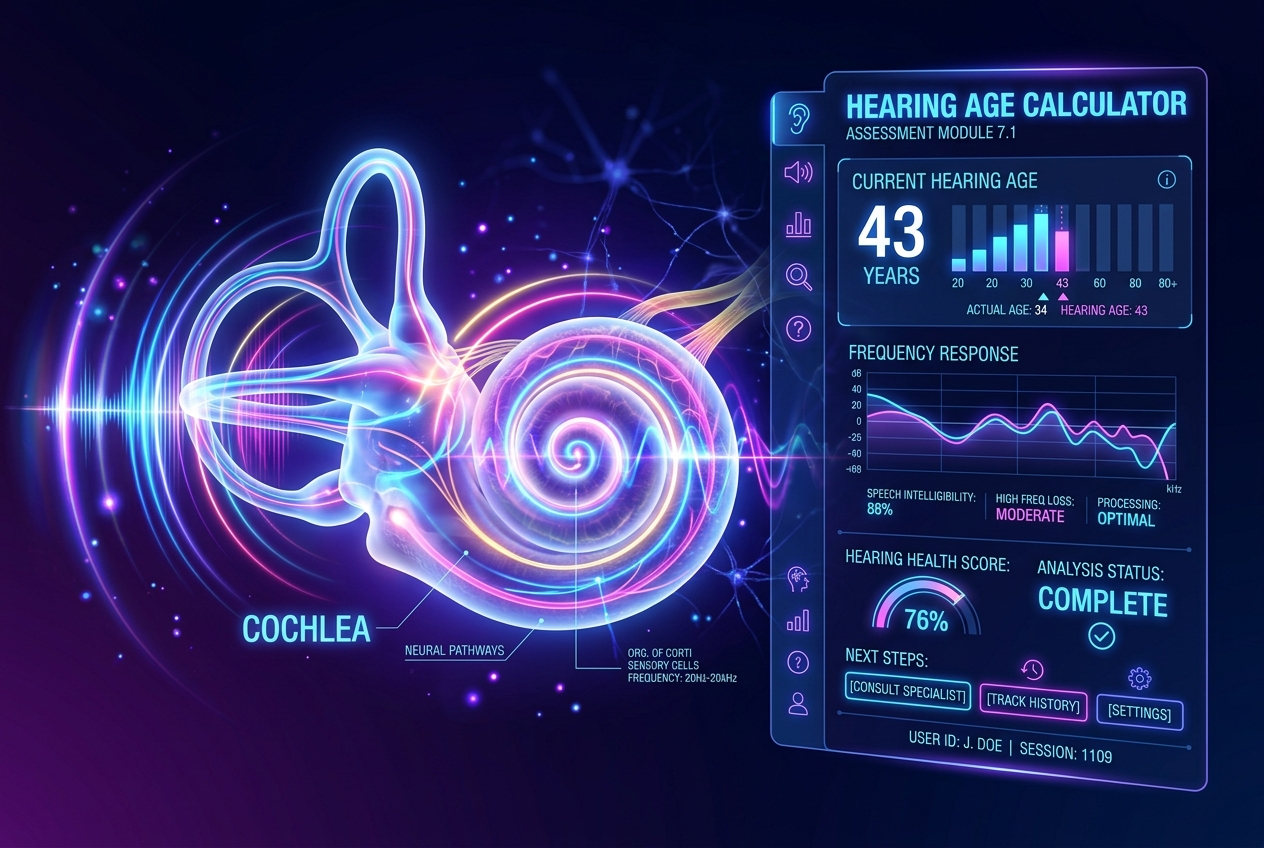
Hearing Age vs. Chronological Age: The Biophysics of Auditory Decline and Presbycusis
Sound is our sensory connection to the universe. From the gentle whisper of a summer breeze to the complex harmonies of a symphony orchestra, our auditory system is a masterclass in biological engineering. Yet, when we examine the cellular architecture of the human ear, we find that auditory time is highly volatile. Your Hearing Age is a physiological metric that measures your high-frequency sound perception limits and compares them to the chronological averages of the population.
While your birth certificate records your chronological age, your inner ear's delicate sensory cells may be aging at a completely different rate. A 40-year-old software engineer exposed to years of loud headphone usage may possess the hearing age of an 80-year-old, unable to hear frequencies above 10 kHz. Conversely, an elderly rural farmer who has lived in quiet environments may maintain a hearing age of a 25-year-old.
This detailed clinical guide unpacks the biophysical and neurological mechanisms of hearing loss. We will study the structural anatomy of the cochlea, explore why high-frequency hearing decays first, discuss the strong link between hearing loss and cognitive decline, and establish a scientific protocol to conserve your hearing and reverse auditory age.
"He who has ears to hear, let him hear. For our sense of sound is a direct physical bridge between our mind and the cosmic frequencies of our world." > — Ancient Universal Maxim
Section I: The Auditory Transduction Machine: How We Hear
To understand hearing age, we must trace the path of a sound wave as it is converted from air pressure fluctuations into electrical signals in the brain.
1. Mechanical Amplification: From Eardrum to Cochlea * Sound waves are collected by the outer ear (pinna) and funneled into the external auditory canal, causing the tympanic membrane (eardrum) to vibrate. * These vibrations are mechanically transmitted and amplified by the three tiniest bones in the human body—the malleus, incus, and stapes (ossicles)—located in the middle ear. * The stapes acts like a piston, pushing against the oval window of the cochlea, the fluid-filled, spiral-shaped organ of the inner ear.
2. The Basilar Membrane: Frequency Tuning As fluid waves travel through the cochlea, they deform the elastic basilar membrane: * Base of the Cochlea: Narrow and stiff, vibrating only in response to high-frequency sounds (up to 20,000 Hz). * Apex of the Cochlea: Wide and floppy, vibrating only in response to low-frequency sounds (down to 20 Hz).
This spatial arrangement of frequency sensitivity is called tonotopic organization—a biological layout that is maintained all the way from the cochlea to the auditory cortex in your brain.
Section II: The Cellular Engines of Sound: Hair Cells and Stereocilia
The actual conversion of mechanical movement into electrical nerve impulses is handled by the Organ of Corti, which sits atop the basilar membrane. This structure is packed with specialized sensory cells called Hair Cells:
1. Outer Hair Cells (OHCs) vs. Inner Hair Cells (IHCs) * Inner Hair Cells (approx. 3,500): The primary sensory receptors. When they bend, they release neurotransmitters that send electrical signals along the auditory nerve to the brain. * Outer Hair Cells (approx. 12,000): The "cochlear amplifiers." They possess a unique membrane protein called prestin that allows them to physically contract and expand in sync with incoming sound waves. This contraction mechanically amplifies weak vibrations, allowing us to hear incredibly soft sounds.
Outer Cochlear Hair Cell Retention Rate
Highlighting the permanent attrition of auditory sensory cells over chronological life.
2. The Biophysics of Hair Cell Damage At the top of each hair cell are tiny, hair-like projections called stereocilia, arranged in precise rows. Stereocilia are connected to one another by thin protein strands called tip links: * As sound waves move the basilar membrane, the stereocilia bend. * This bending pulls on the tip links, mechanically opening ion channels that allow potassium ($K^+$) and calcium ($Ca^{2+}$) to flood into the hair cell, creating an electrical signal. * The Catch: Human hair cells are non-mitotic—meaning they cannot divide, regenerate, or heal. We are born with a finite number of them. If intense sound waves or oxidative stress break the tip links or shear off the stereocilia entirely, those hair cells die permanently.
Section III: Presbycusis and High-Frequency Auditory Decay
The age-related loss of hearing is medically known as presbycusis. It is characterized by a slow, progressive, symmetrical decline in high-frequency hearing sensitivity over several decades.
1. Why High Frequencies Go First The base of the cochlea, which processes high-frequency sounds, is the first to suffer from physical wear and tear: * Every sound wave that enters the cochlea, regardless of frequency, must pass through the base first before traveling deeper. * This means the base is subjected to constant mechanical stress and high metabolic demands throughout our lives. * The blood supply to the cochlea, via the stria vascularis, is highly vulnerable to cardiovascular decline, leading to localized oxygen starvation (ischemia) and hair cell death at the base.
Auditory High-Frequency Limit Decay
Comparing maximum perceivable high frequency threshold across chronological age.
2. Standard Hearing Age Thresholds As we age chronologically, the maximum frequency we can perceive drops in a predictable curve: * Age Under 20: Can hear frequencies up to 18,000 to 20,000 Hz. * Age 30: Maximum frequency drops to around 15,000 to 16,000 Hz. * Age 50: Maximum frequency drops to around 12,000 Hz. * Age 70+: Maximum frequency is often restricted to 8,000 Hz or lower, making it extremely difficult to understand speech, especially in noisy environments.
This predictable decline is what allows our hearing age calculators to map your high-frequency hearing threshold directly to a physiological "hearing age."
Section IV: The Direct Link: Hearing Age, Brain Shrinkage, and Dementia
One of the most critical areas of modern neurology is the deep relationship between hearing loss and cognitive decline. Studies by researchers at Johns Hopkins University have revealed that mild hearing loss doubles dementia risk, moderate loss triples it, and severe hearing loss makes an individual five times more likely to develop cognitive impairment.
1. Cognitive Load Hypothesis When your hearing age is advanced and you struggle to hear high-frequency consonant sounds (such as "s," "f," "t," and "th"), your brain has to work incredibly hard just to decode incoming speech. This constant extra effort drains resources from your working memory and executive networks, leaving you with less mental capacity for deep thinking, memory consolidation, and reasoning.
2. Brain Structural Atrophy When sensory cells in the cochlea die, the corresponding neurons in the primary auditory cortex (located in the temporal lobes of the brain) go silent. Deprived of normal sensory input, these brain regions begin to shrink and atrophy. Brain scans of individuals with unaddressed hearing loss show accelerated loss of grey matter volume in regions critical for speech, memory, and spatial orientation.
3. Social Isolation and Sensory Deprivation When communication becomes stressful and frustrating due to high hearing age, individuals often pull back from social activities, family gatherings, and intellectual discussions. This social isolation removes rich mental stimulation, accelerating cognitive decline and driving up overall mental age.
Section V: The Scientific Protocol to Safeguard Your Hearing Age
While dead hair cells cannot be brought back to life, you can take immediate, science-backed steps to slow down auditory aging, preserve your remaining cochlear structures, and maintain optimal brain health.
1. Safe Listening Thresholds: The "60/60" Rule * The Danger Zone: Sound levels above 85 decibels (dB) can cause permanent cochlear damage with prolonged exposure. Standard headphones at maximum volume can reach up to 105 to 110 dB, a level capable of causing damage in just minutes. * The Rule: Keep your headphone volume below 60% of maximum, and limit listening to no more than 60 minutes at a time. * Use Active Noise Canceling (ANC): ANC headphones block out background noise, preventing the need to turn up your music volume to compete with traffic or airplane engines.
2. Targeted Antioxidant Therapy for Cochlear Stress Intense sound exposure triggers massive releases of free radicals in the cochlea, which damage hair cell membranes. You can shield these delicate cells using targeted nutritional support: * Magnesium (200-400 mg daily): Acts as a natural calcium-channel blocker, preventing the damaging influx of calcium into overstimulated hair cells and preserving local blood flow. * Vitamins A, C, and E + Alpha-Lipoic Acid (ALA): Research shows that combining these powerful antioxidants before and after loud sound exposure significantly reduces noise-induced hearing loss.
3. Auditory Training: Exercises for the Brain You can train your auditory cortex to become more efficient at processing sound, compensating for physical cochlear decline: * The Speech-in-Noise Challenge: Spend 15 minutes daily listening to audiobooks or podcasts at a low volume with background ambient noise playing, focusing intensely on deciphering every word. * Binaural Auditory Practice: Close your eyes and focus on identifying the exact direction, distance, and height of subtle sounds in your environment (such as a ticking clock or bird song), building your brain's spatial processing maps.
Frequently Asked Questions (FAQs)
Q1: Can high-frequency hearing loss be reversed? No, sensorineural hearing loss is currently permanent. Once cochlear hair cells die, they cannot regenerate in humans. However, groundbreaking clinical trials are currently investigating gene therapies and stem cell treatments to jumpstart hair cell regrowth. For now, prevention and strict protection are absolutely vital to preserve your hearing.
Q2: Why does hearing loss make it hard to understand people even if they sound "loud" enough? This is because age-related hearing loss selectively damages high-frequency hearing first. In speech, low frequencies provide the volume of vowel sounds, while high frequencies provide the clarity of consonant sounds (like "s," "f," "p," "k"). Without high frequencies, speech sounds like a loud, muffled mumble, making it very hard to separate words.
Q3: When should I get a professional hearing test? You should get an audiogram from a certified audiologist if you experience persistent ringing in your ears (tinnitus), regularly have to ask people to repeat themselves, or struggle to follow conversations in busy restaurants. Early diagnosis and proactive use of modern hearing aids can prevent brain atrophy and protect your cognitive health.
"The quiet of the universe is not a void, but a canvas. Protect your hearing, so that you may continue to appreciate the subtle, beautiful notes of life's grand orchestra." > — Legendary Auditory Wisdom