The Chronological Age of the Cosmos: Decoding Deep Time and Radiometric Dating
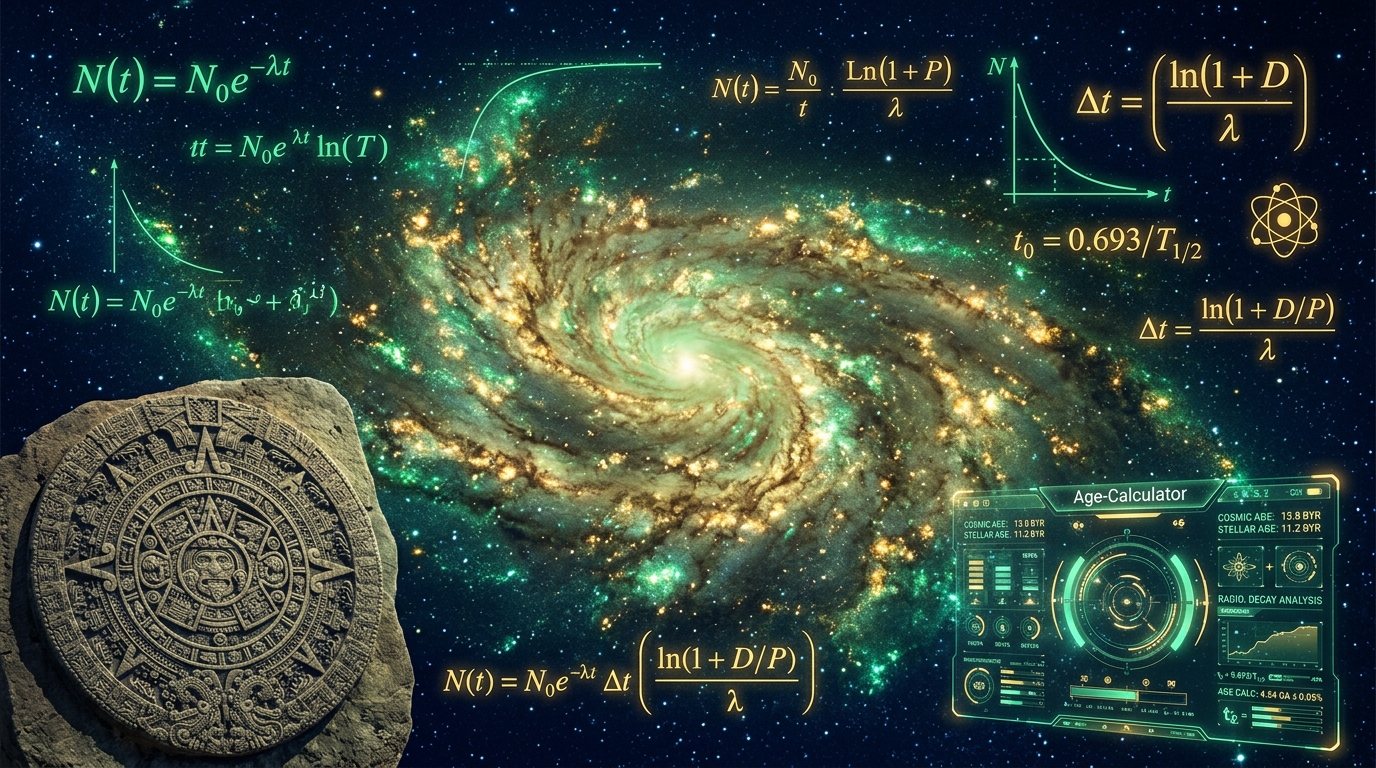
The Chronological Age of the Cosmos: Decoding Deep Time and Radiometric Dating
To the human mind, time is an intimate, deeply personal experience. We measure our lives in decades, remember our childhoods in years, and plan our days down to the second. Our personal chronological calculations are anchored to the steady, reliable cycles of our home planet: the Earth spinning on its axis to create day and night, and orbiting the Sun to mark the turning of the years.
But what happens when we look beyond the boundaries of our planetary cradle? What happens when we turn our telescopes to the night sky and ask the ultimate chronological question: How old is the stage upon which the entire drama of human existence is being played? How do we calculate the chronological age of the Earth, the Solar System, and the very Universe itself?
For most of human history, the answers to these questions were the exclusive domain of mythology, theology, and philosophical speculation. It is only within the last century that modern science—through a magnificent fusion of nuclear physics, geochemistry, stellar astrophysics, and observational cosmology—has succeeded in building a precise, mathematically rigorous Cosmological and Geological Time Calculator.
Today, we know with extraordinary precision that the chronological age of the Earth is 4.54 billion years (accurate to within a margin of error of less than 1%), and the chronological age of the Universe is 13.787 billion years (with an error margin of a mere 0.1%).
This comprehensive scientific treatise explores the advanced calculations behind these cosmic numbers. We analyze the mathematics of Radioactive Decay and Radiometric Dating, explore how meteorites provide a pristine snapshot of the Solar System’s birth, examine the equations of Hubble's Law and Cosmological Expansion, and decipher the ancient "baby picture" of the cosmos: the Cosmic Microwave Background (CMB).
"The cosmos is within us. We are made of star-stuff. We are a way for the universe to know itself." > — Carl Sagan
Section I: The Mathematics of Radiometric Dating and Geological Time
To calculate the chronological age of Earth, we cannot rely on historical records or written calendars. We must look to the rocks themselves. Deep within the crystalline structures of ancient minerals, nature has embedded its own immutable, highly precise atomic clocks: radioactive isotopes.
The scientific discipline of Geochronology utilizes the concept of Radiometric Dating to calculate when a mineral crystallized from magma or was subjected to high-temperature geological events. This method is based on the constant, statistically predictable rate at which unstable "parent" atoms decay into stable "daughter" atoms.
The fundamental mathematical law governing radioactive decay is expressed as a first-order differential equation:
$$\frac{dN}{dt} = -lambda N$$
Where: * $N$ is the number of radioactive parent atoms remaining at time $t$. * $lambda$ is the decay constant, representing the probability of decay per unit time for a single atom.
Solving this differential equation yields the classic exponential decay formula:
$$N(t) = N_0 e^{-lambda t}$$
Where: * $N_0$ is the initial number of parent atoms at $t = 0$ (the moment the mineral crystallized and "locked" the isotopic system).
To calculate the elapsed time $t$ (the chronological age of the rock), we measure the current number of parent atoms $N$ and the number of accumulated stable daughter atoms $D$. Since every decayed parent atom becomes a daughter atom, the total number of atoms remains constant:
$$N_0 = N + D$$
Substituting this into the decay equation allows us to solve for time $t$:
$$N = (N + D) e^{-lambda t}$$ $$e^{lambda t} = \frac{N + D}{N} = 1 + \frac{D}{N}$$ $$t = \frac{1}{lambda} lnleft( 1 + \frac{D}{N} \right)$$
This elegant formula is the mathematical engine behind all radiometric dating methods. By measuring the current ratio of daughter-to-parent isotopes ($\frac{D}{N}$) using high-precision mass spectrometers, geochemists can calculate the exact chronological age of a rock or mineral sample.
Section II: Uranium-Lead Geochronology and the Age of the Earth
While there are many radioactive isotopes in nature, the absolute gold standard for measuring geological deep time is the Uranium-Lead (U-Pb) Decay Chain. This system is exceptionally powerful because it contains two separate, independent, and parallel decay clocks within the exact same mineral:
- The Uranium-238 to Lead-206 Clock:
- $$^{238}\text{U} \rightarrow ^{206}\text{Pb} quad left(t_{1/2} = 4.468 \text{ billion years}\right)$$
- The Uranium-235 to Lead-207 Clock:
- $$^{235}\text{U} \rightarrow ^{207}\text{Pb} quad left(t_{1/2} = 704 \text{ million years}\right)$$
Where $t_{1/2}$ represents the half-life of the isotope—the time required for exactly half of the parent atoms to decay. The half-life is mathematically related to the decay constant $lambda$ by:
$$t_{1/2} = \frac{ln(2)}{lambda}$$
The Miracle of Zircon Crystals To perform U-Pb dating, geologists target a highly resilient, microscopic mineral called Zircon ($ZrSiO_4$). Zircon is the perfect geological vault for three reasons: * Extreme Durability: Zircon crystals are chemically inert and have an incredibly high melting point, allowing them to survive weathering, tectonic subduction, and metamorphic heating events that destroy other minerals. * Uranium Affinity: When zircon crystallizes from magma, its crystal lattice readily accepts uranium ($U^{4+}$) ions, but completely rejects lead ($Pb^{2+}$) ions due to differences in ionic charge and radius. * Zero Initial Lead: This means that at the moment of crystallization, the zircon contains a significant amount of radioactive uranium, but absolutely zero lead ($D_0 = 0$). Any lead found inside a zircon crystal today is guaranteed to have been generated by the slow, radioactive decay of uranium over geological epochs.
By plotting the isotopic ratios of $^{206}\text{Pb}/^{238}\text{U}$ against $^{207}\text{Pb}/^{235}\text{U}$, geochemists construct a curve called the Concordia Diagram. If the two independent uranium-lead clocks yield the exact same age, the data point plots directly on the concordia line, providing a mathematically robust, self-checking validation of the sample's chronological age.
Section III: Deciphering the Birth of the Solar System: Meteorites
If geologists scour the Earth for the oldest possible rocks, why can we not find a rock that is exactly 4.54 billion years old?
The reason is Tectonic Recycling. The Earth is a highly active, dynamic planet. Plate tectonics, volcanism, subduction, and erosion have continuously melted, crushed, and recycled the Earth's crust, erasing almost all physical traces of its earliest infancy. The oldest intact terrestrial minerals ever found are tiny zircon grains from the Jack Hills in Western Australia, which date back to 4.404 billion years—an incredible age, but still roughly 130 million years younger than the planet itself.
To calculate the true birth of our planetary home, we must look to space.
When the Solar System formed, it began as a massive, rotating disk of gas and cosmic dust known as the Solar Nebula. Over time, this dust began to condense, clump, and accrete to form the planets, moons, and asteroids.
Asteroids, unlike planets, are cold, geologically dead bodies. They do not experience plate tectonics, weathering, or melting. Therefore, the asteroids and the meteorites that break off from them serve as pristine, unaltered "time capsules," preserving the exact chemical and isotopic state of the Solar Nebula at the moment the Solar System solidified.
By analyzing a specific class of meteorites called Chondrites (specifically their Calcium-Aluminum-Rich Inclusions, or CAIs), scientists have identified the oldest solid materials in the Solar System. Using U-Pb radiometric dating on these CAIs yields a definitive age of:
$$\text{Age of the Solar System} = 4.5673 \text{ billion years} pm 160,000 \text{ years}$$
By combining this metric with isotopic measurements of Earth’s bulk lead composition (the famous Lead-Lead dating method pioneered by Clair Patterson in 1953), scientists concluded that the Earth accreted and formed its core shortly after the CAIs solidified, locking its chronological age at 4.54 billion years.
| Isotopic Parent | Decay Product | Half-Life ($t_{1/2}$) | Primary Geological Target | Effective Chronological Range | | :--- | :--- | :--- | :--- | :--- | | Uranium-238 ($^{238}\text{U}$) | Lead-206 ($^{206}\text{Pb}$) | 4.468 Billion Years | Zircon, Monazite | 10 Million to 4.6 Billion Years | | Uranium-235 ($^{235}\text{U}$) | Lead-207 ($^{207}\text{Pb}$) | 704 Million Years | Zircon, Baddeleyite | 10 Million to 4.6 Billion Years | | Potassium-40 ($^{40}\text{K}$) | Argon-40 ($^{40}\text{Ar}$) | 1.251 Billion Years | Mica, Feldspar, Hornblende | 100,000 to 4.6 Billion Years | | Carbon-14 ($^{14}\text{C}$) | Nitrogen-14 ($^{14}\text{N}$) | 5,730 Years | Organic Matter, Charcoal | 100 to 50,000 Years |
Section IV: Decoding the Chronological Age of the Universe: The Cosmic Horizon
Calculating the age of our planet is an extraordinary achievement, but it represents only a small fraction of cosmic history. To calculate the chronological age of the Universe itself, we must shift our scale from geology to astrophysics and cosmology.
How do we date a Universe? The first clue came in 1929, when the legendary astronomer Edwin Hubble made a revolutionary discovery: the Universe is expanding.
By measuring the distances to remote galaxies and analyzing the light they emit, Hubble observed that galaxies are moving away from us. Furthermore, the velocity of their recession is directly proportional to their distance from Earth. This relationship is known as Hubble's Law:
$$v = H_0 d$$
Where: * $v$ is the galaxy's recessional velocity (measured via the redshift of its light). * $d$ is the galaxy's distance from Earth. * $H_0$ is the Hubble Constant, which measures the rate of cosmic expansion.
The Hubble Time: A Back-of-the-Envelope Calculation If the Universe is expanding today, it means that in the past, galaxies must have been closer together. If we rewind the cosmic movie backward in time, there must have been a single, infinitely dense point where all matter and space were concentrated—the Big Bang.
If we assume the expansion rate has been constant throughout cosmic history, we can perform a simple back-of-the-envelope calculation to estimate when this Big Bang occurred. The time $t$ required for a galaxy at distance $d$ to travel away from us at velocity $v$ is simply distance divided by velocity:
$$t_{\text{Hubble}} = \frac{d}{v}$$
Substituting Hubble's Law ($v = H_0 d$) into this equation yields:
$$t_{\text{Hubble}} = \frac{d}{H_0 d} = \frac{1}{H_0}$$
This value, $\frac{1}{H_0}$, is known as the Hubble Time. It represents a crude, baseline estimate for the age of the Universe.
Modern measurements place the Hubble Constant at approximately $70 \text{ km/s/Mpc}$ (kilometers per second per megaparsec). Let us convert this cosmological value into standard time units: * $1 \text{ Megaparsec (Mpc)} approx 3.086 \times 10^{19} \text{ km}$.
$$\frac{1}{H_0} approx \frac{3.086 \times 10^{19} \text{ km}}{70 \text{ km/s}} approx 4.41 \times 10^{17} \text{ seconds}$$
Converting seconds to years: $$t_{\text{Hubble}} approx \frac{4.41 \times 10^{17} \text{ s}}{3.154 \times 10^7 \text{ s/year}} approx 14 \text{ billion years}$$
This simple back-of-the-envelope math yields an age remarkably close to the true value, proving that the Universe has a finite chronological origin.
Section V: The Precision Era of Cosmology: The Friedmann Equations and Planck
While the Hubble Time assumes a constant, linear expansion rate, the real Universe is far more complex. The expansion rate of the cosmos is dynamically governed by the density of its contents—including ordinary matter, dark matter, and a mysterious anti-gravitational force called Dark Energy (the Cosmological Constant).
To calculate the exact age of the Universe, astrophysicists utilize the Friedmann Equations, which are derived from Albert Einstein’s Theory of General Relativity. In the standard model of cosmology (known as the $Lambda\text{CDM}$ Model), the age of the Universe $t_0$ is calculated by integrating the cosmic expansion rate over time:
$$t_0 = int_{0}^{1} \frac{da}{a H(a)}$$
Where: * $a$ is the cosmic scale factor (representing the relative size of the expanding Universe, where $a=1$ today). * $H(a)$ is the expansion rate at scale factor $a$, defined by the Friedmann equation:
$$H(a) = H_0 sqrt{Omega_r a^{-4} + Omega_m a^{-3} + Omega_k a^{-2} + Omega_Lambda}$$
Where: * $Omega_r$ is the radiation density parameter (photons and neutrinos). * $Omega_m$ is the total matter density parameter (baryonic matter and dark matter). * $Omega_k$ is the spatial curvature density parameter (found to be exactly zero, indicating a flat Universe). * $Omega_Lambda$ is the dark energy density parameter.
The Planck Satellite Breakthrough In 2015 and 2018, the European Space Agency’s Planck Satellite measured the Cosmic Microwave Background (CMB)—the thermal radiation left over from the Big Bang, dating back to when the Universe was just 380,000 years old.
By analyzing the microscopic temperature fluctuations (anisotropies) in the CMB, Planck determined the exact composition of our Universe: * Dark Energy ($Omega_Lambda$) = 68.5% * Dark Matter ($Omega_{dm}$) = 26.6% * Ordinary Matter ($Omega_b$) = 4.9% * Hubble Constant ($H_0$) = $67.4 \text{ km/s/Mpc}$
Plugging these incredibly precise parameters into our Friedmann integration yields the definitive, internationally accepted chronological age of our cosmos:
$$t_0 = 13.787 \text{ billion years} pm 20 \text{ million years}$$
Universe Temperature Decline vs. Chronological Time Elapsed
Logarithmic scale mapping the cooling of the cosmos since the Big Bang.
Section VI: Nucleocosmochronology and Stellar Evolutionary Clocks
To validate this extraordinary cosmological calculation, astrophysicists have developed independent, parallel dating methods that act as internal checks. If the Universe is 13.787 billion years old, then no object inside the Universe should be older than this limit.
Let us explore two prominent astrophysical dating clocks:
1. White Dwarf Cooling Curves When stars like our Sun reach the end of their nuclear-fusing lives, they shed their outer layers and leave behind a dense, hot core called a White Dwarf. White dwarfs no longer fuse elements; they simply glow with residual heat, slowly cooling down into the cold vacuum of space.
By measuring the temperature and luminosity of the oldest, coolest white dwarfs in nearby globular clusters, and applying thermodynamic cooling equations, astrophysicists can calculate how long they have been cooling. The oldest white dwarfs in our galaxy are found to be approximately 11.5 to 12.5 billion years old, providing a solid lower bound for the age of the Milky Way.
2. Nucleocosmochronology Similar to terrestrial radiometric dating, Nucleocosmochronology measures the abundance of long-lived radioactive elements (such as uranium and thorium) in the atmospheres of the Universe's oldest, metal-poor stars.
Because these stars formed in the earliest epochs of galactic history, their atmospheres preserve a pristine sample of the isotopes generated by early supernovae. By measuring the ratio of $^{232}\text{Th}/^{238}\text{U}$, astrophysicists calculate star ages ranging from 12.5 to 13.5 billion years, confirming that the stars are indeed slightly younger than the Universe itself.
Section VII: Frequently Asked Questions (FAQ)
How do scientists calculate the chronological age of the Earth with such precision? Scientists calculate the chronological age of the Earth using radiometric dating on pristine geological materials. Because plate tectonics and weathering recycle and destroy the Earth’s earliest crust, geologists analyze ancient, unaltered meteorites (specifically chondrites and Calcium-Aluminum-Rich Inclusions) that formed during the birth of the Solar Nebula. By measuring the ratios of Uranium isotopes decaying into Lead isotopes inside these meteorites using high-precision mass spectrometers, scientists lock the age of the Earth at 4.54 billion years with an error margin of less than 1%.
What is the Hubble Constant and how is it used to date the Universe? The Hubble Constant ($H_0$) measures the current rate at which the Universe is expanding. By measuring the distance and recessional velocity of distant galaxies, we can "rewind" the expansion mathematically. The inverse of the Hubble Constant ($\frac{1}{H_0}$), known as the Hubble Time, provides a baseline estimate of when the expansion began (roughly 14 billion years ago). By refining this expansion rate with Einstein's Friedmann equations and incorporating dark matter, ordinary matter, and dark energy density, we calculate the precise age of the Universe as 13.787 billion years.
How do radioactive half-lives serve as natural astronomical clocks? Radioactive half-lives are governed by the laws of quantum mechanics and nuclear physics. Unstable atomic nuclei decay into stable isotopes at a mathematically constant, predictable exponential rate that is completely unaffected by external physical conditions such as temperature, pressure, gravity, or chemical bonding. Because this rate of decay is immutable, measuring the ratio of accumulated daughter atoms to remaining parent atoms in a closed system (like a crystallized zircon grain or a meteorite) allows us to back-calculate the exact elapsed chronological time since the system was formed.
Conclusion: Finding Our Place in Cosmic Time
The journey to calculate the chronological age of the Earth and the Universe is one of the most triumphant chapters in human intellectual history. It demonstrates that the human mind, operating from a tiny, fragile planetary outpost in a vast and silent cosmos, is capable of deciphering the deepest, most ancient secrets of time.
Our personal lifespans, tracked by our simple age calculators, are microscopic blinks in the context of deep time. The 4.54 billion years of Earth's history and the 13.787 billion years of cosmic history dwarf the brief, precious moments we spend on this planet. Yet, rather than making us feel insignificant, this realization should fill us with profound awe and gratitude.
We are made of the very carbon, oxygen, and iron forged in the cores of dying stars billions of years ago. We are, quite literally, the stardust of the early Universe, organized into conscious beings capable of measuring, tracking, and understanding the temporal flow of the cosmos. As we use our chronological clocks and scientific tools to map our position in the stream of time, we fulfill our ultimate cosmic calling: to serve as the eyes, the minds, and the hearts through which the Universe can contemplate, appreciate, and celebrate its own spectacular, ancient journey.