Canine & Feline Chrono-Genetics: The Logarithmic Epigenetic Formula of Pet Aging vs. Human Years
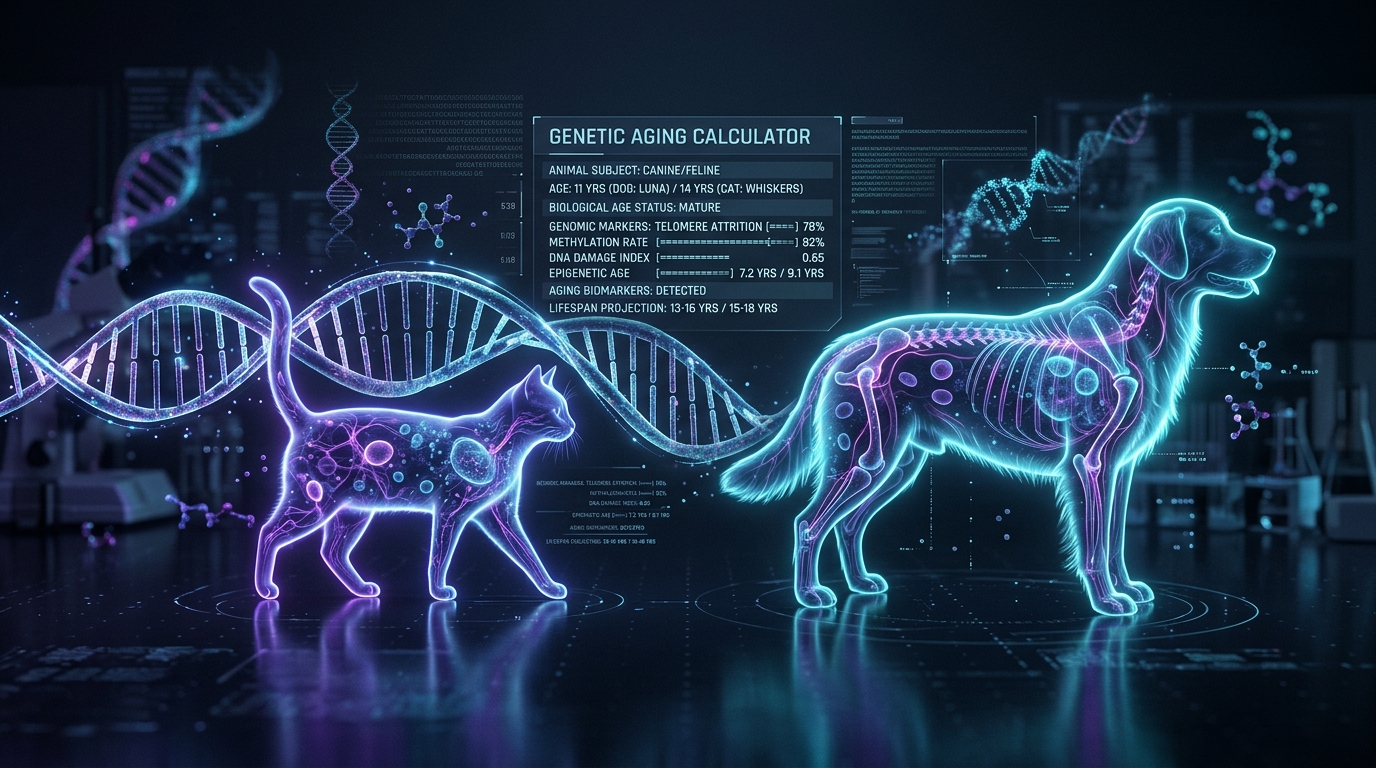
Canine & Feline Chrono-Genetics: The Logarithmic Epigenetic Formula of Pet Aging vs. Human Years
For generations, pet owners have relied on a deceptively simple rule of thumb to understand their pets' age: the classic "multiply by seven" rule. Under this old paradigm, a one-year-old dog was considered equivalent to a seven-year-old human, and a ten-year-old cat was deemed seventy. It was an elegant, easy-to-remember heuristic, but mathematically and biologically, it is a complete myth.
With the rapid emergence of epigenetics and high-throughput genomic sequencing, geneticists have unlocked the true chronological and biological pace of pet aging. This deep-dive exploration dismantles the old linear myth and introduces the modern logarithmic formula developed by researchers at the University of California, San Diego (UCSD) school of medicine. Based on the concept of DNA methylation and molecular epigenetic clocks, this article provides the ultimate guide to understanding how our canine and feline companions age, how different breeds diverge chronologically, and how to use exact scientific age calculation to optimize their health span.
The Universal Truth of Mammalian Ontogeny
The Universal Truth: > Mammalian development and senescence are fundamentally non-linear processes. In almost all mammals, the early stages of life exhibit extremely accelerated physiological and genetic aging, which rapidly decelerates as adulthood is achieved.
This universal biological law explains why a one-year-old dog can reproduce, run, and display fully developed cognitive behaviors, whereas a seven-year-old human child is still in early primary education and years away from physical maturity. The linear "multiply by 7" rule completely breaks down at the beginning and the end of life. To truly align dog years with human years, we must turn to logarithmic mathematics.
Part I: The Epigenetic Breakthrough — DNA Methylation and the Horvath Clock
To understand the science of pet age calculation, we must first understand epigenetics. Every cell in a dog’s or cat’s body contains the exact same DNA sequence (the genome). However, as an organism grows, different genes must be turned "on" or "off" to build organs, regulate metabolism, and guide development.
One of the primary mechanisms for regulating gene expression is DNA methylation. This process involves the attachment of tiny chemical tags, called methyl groups, to specific cytosine bases within the DNA molecule. These methyl groups act like tiny volume knobs, silencing or whispering genetic instructions.
In 2013, UCLA researcher Dr. Steve Horvath discovered that these DNA methylation patterns change in a highly predictable, mathematically precise manner as an organism ages. By measuring the methylation levels at hundreds of specific sites across the genome, scientists can construct an epigenetic clock (or biological age clock). This clock does not measure arbitrary calendar days; it measures the actual wear and tear, cellular maturity, and functional decline of the biological tissues.
In 2020, a team of researchers led by Dr. Trey Ideker at UC San Diego applied this exact same epigenetic methodology to dogs. They gathered blood samples from over 100 Labrador Retrievers ranging from a few weeks old to 16 years of age. They sequenced the methylomes of these dogs and compared them directly to the methylomes of humans.
The results were astonishing. The molecular aging curves of dogs and humans mapped onto each other beautifully—but only when plotted on a logarithmic scale.
Part II: The UCSD Logarithmic Dog Aging Formula
The UC San Diego research team formulated a mathematical model that maps the epigenetic age of dogs directly to human biological years. The formula uses the natural logarithm (ln) of the dog's chronological age in calendar years:
$$\text{Human Equivalent Age} = 16 \times \ln(\text{Dog Chronological Age}) + 31$$
The Mathematics Behind the Formula The natural logarithm ($$\ln$$) is a mathematical function that grows rapidly at first and then flattens out. This matches the biological reality of canine development: 1. Infancy and Adolescence: A young puppy accumulates epigenetic marks at an extremely rapid rate. 2. Adulthood: Once the dog reaches physical maturity (around 2 to 3 years of age), the rate of epigenetic change dramatically slows down. Each subsequent calendar year represents a much smaller jump in human equivalent years.
Let’s calculate some specific milestones using the UCSD logarithmic formula to see how it compares to the old linear myth:
- At 1 Month (0.083 years):
- $$16 \times \ln(0.083) + 31 = 16 \times (-2.488) + 31 \approx -8.8 \text{ years}$$ (The formula is calibrated for dogs older than 10-12 months, as early infancy is highly dynamic).
- At 1 Year:
- $$16 \times \ln(1) + 31 = 16 \times 0 + 31 = 31 \text{ human years!}$$
- A one-year-old dog has the molecular and cellular maturity of a 31-year-old human.*
- At 2 Years:
- $$16 \times \ln(2) + 31 = 16 \times 0.693 + 31 = 11.1 + 31 \approx 42 \text{ human years.}$$
- At 4 Years:
- $$16 \times \ln(4) + 31 = 16 \times 1.386 + 31 = 22.2 + 31 \approx 53 \text{ human years.}$$
- At 8 Years:
- $$16 \times \ln(8) + 31 = 16 \times 2.079 + 31 = 33.3 + 31 \approx 64 \text{ human years.}$$
- At 12 Years:
- $$16 \times \ln(12) + 31 = 16 \times 2.484 + 31 = 39.7 + 31 \approx 71 \text{ human years.}$$
- At 16 Years:
- $$16 \times \ln(16) + 31 = 16 \times 2.772 + 31 = 44.3 + 31 \approx 75 \text{ human years.}$$
Notice the incredible difference between the linear model and the epigenetic model. Under the linear model (multiply by 7), an 8-year-old dog is 56, and a 16-year-old dog is 112 (an almost impossible human age). Under the epigenetic model, an 8-year-old dog is 64, and a 16-year-old dog is 75. This explains why many dogs remain active, happy seniors for many years—their biological aging process has dramatically slowed down!
Part III: Interactive Chrono-Genetic Pet Aging Curve
Below is a detailed ASCII visualization representing the divergence between the old Linear Dog Years model and the modern Epigenetic (UCSD Logarithmic) model:
`
Human Years
110 | * (Linear 16 yr = 112)
100 | *
90 | *
80 | *
70 | * ===========================# (Epigenetic 12-16 yr)
60 | * ======# (Epigenetic 8 yr = 64)
50 | * ======# (Epigenetic 4 yr = 53)
40 | * ======# (Epigenetic 2 yr = 42)
30 | * ======# (Epigenetic 1 yr = 31)
20 | *
10 |__________________________________________________________________
0 1 2 4 6 8 10 12 14 16 Dog Age
`
Legend:
= Old Linear Myth (Dog Age x 7)
* # = UCSD Epigenetic Logarithmic Model ($$16 \ln(\text{Age}) + 31$$)
Part IV: Detailed Canine Age Comparison Matrix
To help pet owners track this biological progression, we have compiled a highly detailed comparison chart across different stages of life, incorporating breed-size adjustments (which represent the secondary variable in canine life expectancy):
| Chronological Dog Age (Years) | Old Linear Myth (Age x 7) | UCSD Logarithmic Epigenetic Age | Small Breeds (under 20 lbs) Equivalent | Medium Breeds (20-50 lbs) Equivalent | Large Breeds (51-100 lbs) Equivalent | Giant Breeds (over 100 lbs) Equivalent | | :--- | :--- | :--- | :--- | :--- | :--- | :--- | | 0.5 (6 Months) | 3.5 | 20.0 | 15.0 | 16.0 | 18.0 | 22.0 | | 1.0 (1 Year) | 7.0 | 31.0 | 25.0 | 28.0 | 31.0 | 35.0 | | 2.0 | 14.0 | 42.1 | 34.0 | 38.0 | 42.1 | 48.0 | | 3.0 | 21.0 | 48.6 | 40.0 | 44.0 | 49.0 | 56.0 | | 4.0 | 28.0 | 53.2 | 45.0 | 49.0 | 55.0 | 64.0 | | 5.0 | 35.0 | 56.7 | 49.0 | 54.0 | 61.0 | 72.0 | | 6.0 | 42.0 | 59.6 | 53.0 | 58.0 | 66.0 | 80.0 | | 7.0 | 49.0 | 62.1 | 57.0 | 62.0 | 71.0 | 88.0 | | 8.0 | 56.0 | 64.3 | 61.0 | 66.0 | 76.0 | 96.0 | | 9.0 | 63.0 | 66.1 | 65.0 | 70.0 | 81.0 | 104.0 | | 10.0 | 70.0 | 67.8 | 69.0 | 74.0 | 86.0 | 112.0 | | 12.0 | 84.0 | 70.8 | 77.0 | 82.0 | 95.0 | 125.0 | | 15.0 | 105.0 | 74.3 | 89.0 | 94.0 | 108.0 | 140.0 | | 18.0 | 126.0 | 77.2 | 101.0 | 106.0 | 120.0 | 155.0 |
Part V: Feline Chrono-Genetics — The Unique Cat Aging Curve
Cats age along a slightly different physiological and genetic trajectory than dogs. Because there is significantly less size variation among cat breeds (most adult domestic cats weigh between 8 and 15 pounds), their chronological aging curve is much more uniform.
Veterinary research from the American Animal Hospital Association (AAHA) and the International Society of Feline Medicine (ISFM) has established a standardized, three-tiered biological aging curve for felines: 1. The Adolescent Leap: The first year of a cat's life is equivalent to approximately 15 human years. This is the period of rapid physical, hormonal, and behavioral development. 2. The Young Adult Transition: The second year adds another 9 human years, bringing a two-year-old cat to approximately 24 human years. 3. The Linear Plateau: After age two, each subsequent chronological year adds approximately 4 human years to their biological age.
The Cat Aging Mathematical Model For a cat aged $$A \ge 2$$: $$\text{Human Equivalent Age} = 24 + 4 \times (A - 2)$$
Let’s see how this maps out: - A 3-year-old cat: $$24 + 4(1) = 28$$ human years. - A 5-year-old cat: $$24 + 4(3) = 36$$ human years. - A 10-year-old cat: $$24 + 4(8) = 56$$ human years. - A 15-year-old cat: $$24 + 4(13) = 76$$ human years. - A 20-year-old cat: $$24 + 4(18) = 96$$ human years.
This elegant model reveals that while cats start life slightly less accelerated than large dogs, they maintain a highly stable, linear trajectory in seniorhood, allowing many domestic indoor cats to live well into their late teens and early twenties (reaching biological equivalents of 80 to 100 human years).
Famous Quote in Veterinary Science and Companion Biology
To capture the emotional weight of this chronological divergence, we reflect on a famous quote by the Nobel Prize-winning ethnologist and zoologist Konrad Lorenz:
"The bond with a true dog is as lasting as the ties of this earth can ever be." > — Konrad Lorenz
Lorenz understood that the only real tragedy of our companionship with pets is the chronological mismatch of our lifespans. By understanding the genetics of their aging, we can take active, scientific steps to close this gap and extend their biological prime.
Part VI: Clinical Applications — Optimizing Your Pet's Life Span
Why does having an accurate chronological-to-biological age converter matter? It is not just about satisfying curiosity. In modern veterinary medicine, biological age dictates proactive care protocols.
If you treat an 8-year-old Labrador as "56 years old" (linear model), you might delay senior wellness screenings. But if you realize that their cells are epigenetically closer to "64 years old", your veterinarian will recommend advanced diagnostic testing immediately.