The Athletic Peak Matrix: Decoupling Biological Prime from Chronological Age in Elite Sports
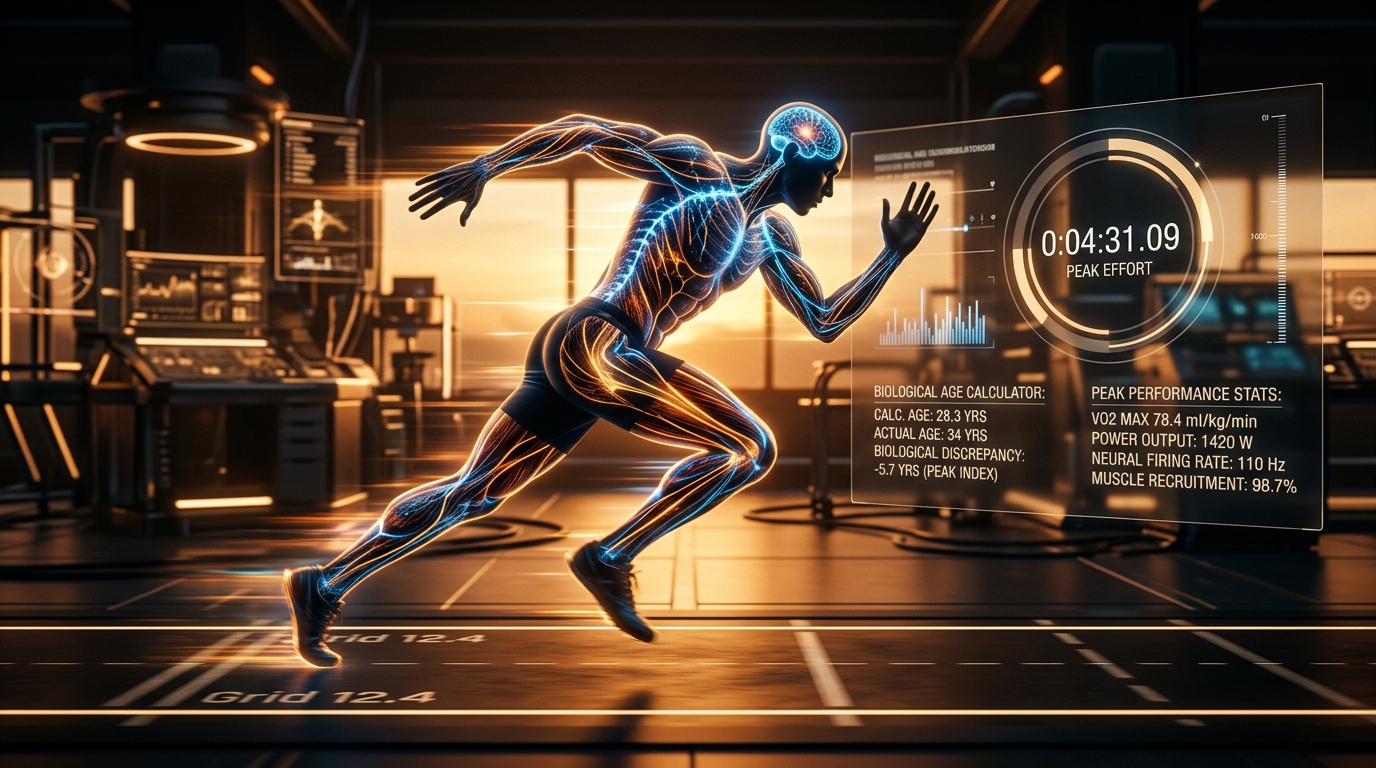
The Athletic Peak Matrix: Decoupling Biological Prime from Chronological Age in Elite Sports
In December of 2024, LeBron James celebrated his 40th chronological birthday. In the history of professional basketball, forty is an ancient age—a chronological marker where almost every player before him had long since retired, their knees worn down, their vertical leaps diminished, their reflexes dulled. Yet, James continued to play at an All-NBA level, logging massive minutes and carrying a physical workload that would break athletes half his age.
A similar phenomenon occurred in American football with Tom Brady, who won a Super Bowl MVP at age 43 and played until 45. In tennis, Novak Djokovic, Rafael Nadal, and Roger Federer dominated the sport deep into their late thirties, long after prior generations faded.
These elite modern gladiators are not merely genetic anomalies. They are the vanguard of a profound revolution in sports medicine, cellular biology, and chronobiology. They have successfully decoupled their biological prime from their chronological age.
This extensive treatise explores the underlying physiological matrices of human athletic aging. We investigate the mechanical, neurological, and mitochondrial factors that determine athletic peak age, analyze the math behind sports-specific decline, and detail the cutting-edge clinical interventions that are pushing the boundaries of human physical longevity.
The Universal Truth of Physical Peak
The Universal Truth: > Human athletic performance is not a single, uniform peak, but an overlapping sequence of distinct physiological primes. Neuromuscular explosive power peaks early, cardiovascular endurance peaks in mid-adulthood, and systemic physical resilience is determined entirely by biological, rather than chronological, optimization.
This biological reality means that while a sprinter might peak chronologically at age 23, an ultra-marathoner may not reach their absolute biological prime until age 35 or 40. By understanding these individual sub-clocks, we can map out and systematically extend our physical potential.
Famous Quote in Athletics and Longevity
To ground this biological exploration in the power of human will, we look to a timeless quote by one of the greatest track and field athletes in history, Jackie Joyner-Kersee:
"Age is no barrier. It's a limitation you put on your mind." > — Jackie Joyner-Kersee
Joyner-Kersee’s words ring truer today than ever. In the modern era of sports science, we are learning that chronological age is merely a count of solar revolutions. True physical capacity is determined by a complex matrix of biological markers that we now have the tools to measure, manage, and optimize.
Part I: The Overlapping Chronobiology of Sports Performance
To analyze why athletes in different disciplines age at different rates, we must break down physical performance into its core physiological components:
1. The Explosive Power & Anaerobic Matrix (Sprinting, Weightlifting, Basketball) * Primary Drivers: Type II (fast-twitch) muscle fibers, creatine phosphate pathways, and neuromuscular firing velocity. * Chronological Peak: 20 to 25 years of age. * Biological Limitation: Fast-twitch muscle fibers are highly susceptible to age-related atrophy (sarcopenia). Additionally, the motor cortex’s ability to send rapid, repetitive electrical signals to the muscles begins a subtle, linear decline starting in the mid-twenties.
2. The Cardiovascular & Glycolytic Matrix (Mid-Distance Running, Soccer, Cycling) * Primary Drivers: VO2 max (maximum oxygen uptake), stroke volume of the heart, and lactate threshold. * Chronological Peak: 24 to 29 years of age. * Biological Limitation: VO2 max decreases by approximately 10% per decade after age 30 in sedentary individuals, and by roughly 5% per decade in highly trained athletes. This is driven by a natural decrease in maximum heart rate (roughly 220 minus chronological age) and a decrease in arterial elasticity.
3. The Ultra-Endurance & Aerobic Matrix (Triathlons, Marathons, Mountaineering) * Primary Drivers: Mitochondrial density, metabolic efficiency, fat oxidation rates, and psychological pain tolerance. * Chronological Peak: 32 to 38 years of age. * Biological Limitation: Aerobic efficiency and muscle glycogen storage capacities are remarkably stable across the lifespan. With proper training, an athlete can maintain a near-peak aerobic baseline well into their late forties and fifties.
Part II: The Anatomy of Decline — Why the Body Ages Chronologically
To understand how super-athletes defy the clock, we must first understand the default biological barriers that chronological time erects within the human machine:
`
Performance %
100 | ==================== (Neuromuscular Explosion Peak: 20-25)
90 | // \\
80 | // \\=================== (Cardiovascular prime: 26-32)
70 | // \\
60 | // \\============= (Endurance Prime: 33-40)
50 | // \\
40 |___//__________________________________________________________________\\______
0 15 20 25 30 35 40 45 50 55 60 Chronological Age
`
1. Mitochondrial Decay and the VO2 Max Cliff At the heart of athletic decline is the mitochondria, the powerhouse of the cell. As we age chronologically, mitochondria accumulate damage to their own DNA (mtDNA) caused by reactive oxygen species (ROS). This leads to mitochondrial dysfunction, resulting in lower ATP (energy) production.
This cellular decay manifests macroscopically as a drop in VO2 max. Since VO2 max is the absolute ceiling of aerobic performance, any drop directly impacts an athlete's recovery rate, stamina, and training capacity.
2. Sarcopenia and Fast-Twitch Muscle Loss Starting around age 30, the human body begins to lose muscle mass at a rate of 3% to 8% per decade, a process known as sarcopenia. Crucially, this loss is not uniform. The body preferentially sheds Type II (fast-twitch) muscle fibers—the fibers responsible for explosive movements, jumping, and sprinting.
This is compounded by a drop in circulating anabolic hormones, specifically testosterone and Growth Hormone (GH), which decreases muscle protein synthesis rates.
3. Collagen Stiffening and Joint Degradation Chronological aging is accompanied by the accumulation of Advanced Glycation End-products (AGEs) in structural tissues. These sugar-protein crosslinks act like biological glue, stiffening collagen fibers in tendons, ligaments, and cartilage.
As tendons lose their elasticity, they lose their ability to store and release elastic energy (the "spring" effect in running and jumping). This stiffening dramatically increases the risk of micro-tears, tendonitis, and joint wear (osteoarthritis), leading to chronic pain and reduced range of motion.
Part III: The Modern Athletic Longevity Protocols
How are athletes like LeBron James defying these physiological laws? The answer lies in targeted, comprehensive biological intervention. These athletes treat their bodies like multi-million dollar scientific laboratories, addressing aging at every structural level.
1. Mitochondrial Preservation and Nootropic Therapy To combat mitochondrial decay, elite sports scientists focus on mitochondrial biogenesis—forcing the body to build new, healthy powerhouses. This is achieved through: * Zone 2 Training: Low-intensity, steady-state cardiovascular exercise performed for extended periods, which optimizes fat-oxidation and maximizes mitochondrial efficiency. * NAD+ Boosters: Supplementation with precursors like Nicotinamide Mononucleotide (NMN) or Nicotinamide Riboside (NR) to maintain cellular energy levels and repair damaged DNA. * CoQ10 and PQQ: Synergistic antioxidants that protect mitochondrial membranes from oxidative damage during extreme physical exertion.
2. Myofibrillar Preservation and Eccentric Loading To halt sarcopenia and preserve explosive power, trainers employ heavy eccentric resistance training and plyometrics. By forcing muscles to contract while lengthening, athletes stimulate high-threshold motor units, preserving fast-twitch fiber architecture deep into chronological masterhood.
This is supported by precise dietary amino-acid timing, ensuring a steady intake of leucine-rich proteins every 3 to 4 hours to maximize muscle protein synthesis and overcome age-related anabolic resistance.
3. Neuromuscular Refinement and Hyperbaric Oxygen Therapy (HBOT) As raw physical capacity drops, elite athletes compensate through neuromuscular efficiency. Over decades of practice, the brain carves highly optimized neural pathways (muscle memory), requiring less energy and effort to perform complex movements.
To accelerate recovery and heal micro-tears in these pathways, athletes utilize Hyperbaric Oxygen Therapy (HBOT). By breathing 100% pure oxygen in a pressurized chamber, they dissolve oxygen directly into their blood plasma, accelerating stem cell mobilization, reducing systemic inflammation, and cutting recovery times in half.
Part IV: Sports Performance Aging Matrix
The table below outlines the expected physiological changes and key optimization metrics across chronological decades for highly active individuals:
| Chronological Age Range | Cardiovascular Indicator (VO2 Max Decay) | Muscular Indicator (Sarcopenia Risk) | Recovery Window (Hours between high-intensity sessions) | Key Biological Aging Marker to Monitor | Primary Optimization Strategy | | :--- | :--- | :--- | :--- | :--- | :--- | | 20 - 29 (The Raw Peak) | Baseline (0% decay) | 100% muscle fiber density | 12 - 24 hours | Inflammatory cytokines (IL-6, TNF-alpha) | Maximum power development & injury prevention | | 30 - 39 (The Transition) | 3% - 5% decay | Minimal loss (if resistance trained) | 24 - 36 hours | Testosterone/Estrogen ratio, Free Cortisol | Zone 2 cardio, progressive overload, sleep sleep hygiene | | 40 - 49 (The Tactical Era)| 8% - 12% decay | 3% - 5% fast-twitch loss | 36 - 48 hours | High-Sensitivity C-Reactive Protein (hs-CRP) | Eccentric loading, joint collagen peptides, NAD+ therapies | | 50 - 59 (The Mastery Era)| 15% - 20% decay | 8% - 12% overall mass loss | 48 - 72 hours | Glycated hemoglobin (HbA1c), Fasting Insulin | Plyometric coordination, heavy resistance training, HRT | | 60+ (The Longevity Era) | 25%+ decay | 15%+ overall muscle decay | 72+ hours | IGF-1, Growth Hormone, Bone Mineral Density | Balance training, functional resistance, compound movements |